
TL/DR:
GG is the precursor molecule that supports your body in the formation of CoQ10 for energy and vitamin K2 for bone strength, thereby powering your cells while guiding calcium into stronger bones.
Have you ever wondered how your body silently crafts the very molecules that keep your heart beating and your bones resilient?
Surprisingly, the answer traces back to a hidden gem- geranylgeraniol (GG) working quietly inside your cells to spark energy production and support nutrient pathways.
Making its mark in wellness buzz, this naturally occurring molecule acts like a hidden “connector,” bridging essential steps in the production of two wellness stars:
- Coenzyme Q10 (CoQ10), your cellular energy sparkplug
- Vitamin K2, the nutrient that guides calcium into bones instead of arteries.
By supporting these pathways, GG plays a pivotal role in energy metabolism, cardiovascular strength, and skeletal health. (1)
Understanding GG’s link with CoQ10 and Vitamin K2 opens a fascinating window into how petite yet powerful behind the scenes player can have a major impact on vitality and longevity.
The Road to Energy: How does your body make CoQ10?
We all need a spark to keep moving, but have you ever been curious about where that spark actually comes from?
Well, your body’s energy spark plug is CoQ10. Found in nearly every cell, CoQ10 fuels the tiny engines (mitochondria) that keep your heart beating, your muscles moving, and your brain sharp.
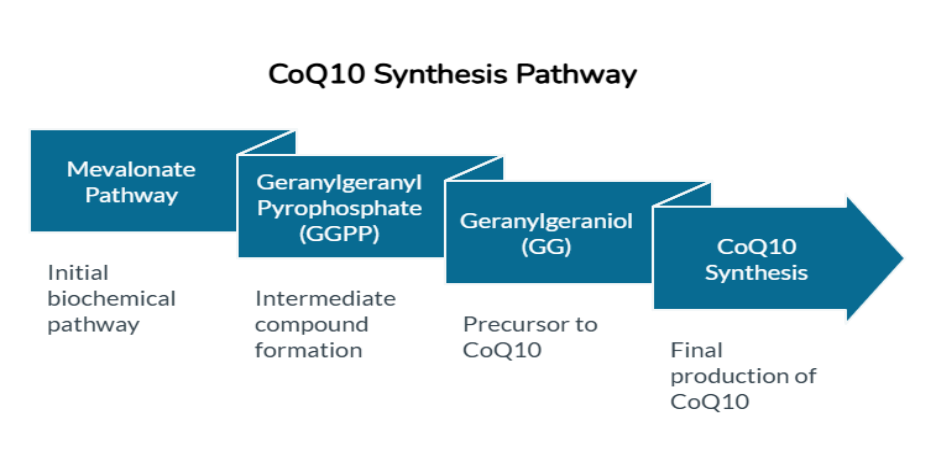
Now comes the most intriguing twist. Before CoQ10 can light up your vitality, your body must carefully build CoQ10 in coordination with GG through a hidden biochemical pathway.
Keep reading to uncover how these pieces connect in the journey ahead.
What Exactly is CoQ10?
CoQ10 is a natural compound that your body makes to help every cell produce energy. It is an essential component of the electron transport chain and is shown to improve symptoms associated with mitochondrial disorders.(2)
It is present in your body cells as ubiquinol and ubiquinone, which continuously keep morphing into one another
- Ubiquinol acts as an antioxidant
- Ubiquinone as an energy cofactor
Both affect gene expression, support DNA repair, and may reduce DNA damage.(3)
To truly appreciate CoQ10, Let’s take a quick look at how our body makes it?
Inside your cells, energy is built step by step. At the heart of mevalonate pathway lies CoQ10, a vital compound that fuels mitochondria and is known as the “power plants” of your body.
What Makes CoQ10 So Essential for Your Body?
The primary function of CoQ10 is its role in cellular energy production, where, along the inner mitochondrial membrane, the electron transport chain (ETC) utilizes CoQ10 as a component in oxidative phosphorylation, converting products of metabolism (carbohydrates, fats, and proteins) into energy as ATP.
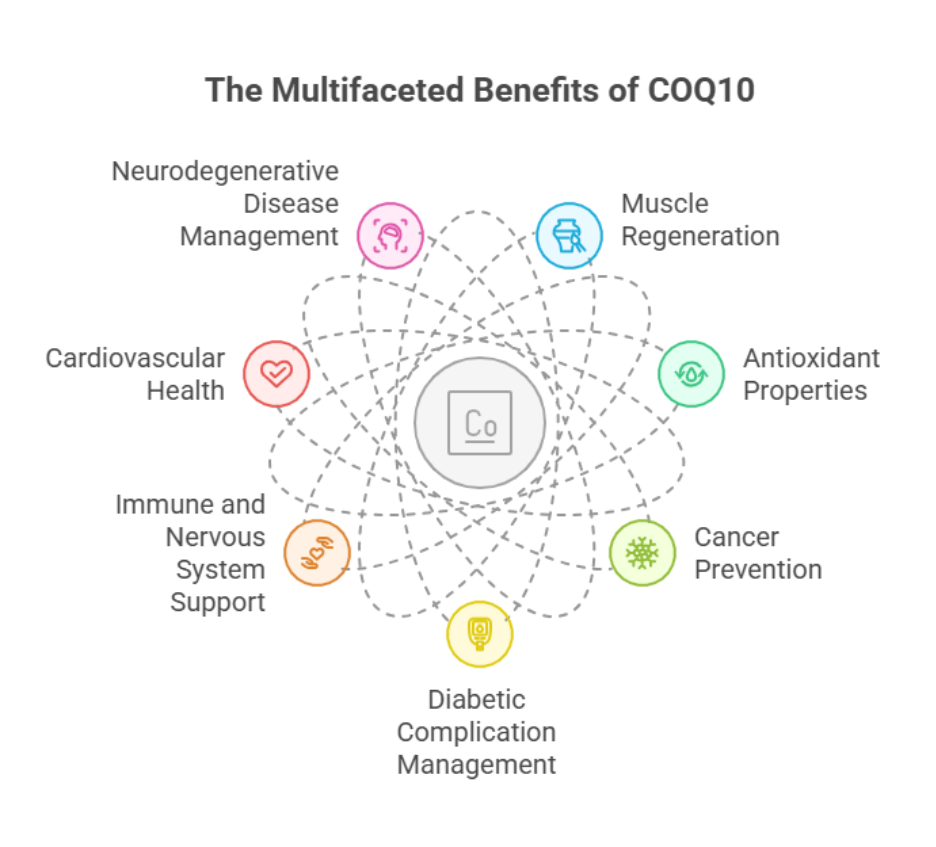
This matters because CoQ10 supports:
- Steady cellular energy
- Antioxidant protection
- Heart and muscle health(3)
Also Read: Protect your heart with CoQ10
Where To Find CoQ10 in Your Daily Diet?
- CoQ10 is found in both plants and animals. However, animal products tend to have the greatest amount of CoQ10 compared with other sources.
- Plant products – broccoli, spinach, soybean/canola/palm oils, nuts, and legumes.
- Animal products- The highest amount can be found in organs such as the heart and liver of meats like beef, pork, chicken, followed by muscles of meats and fatty fish.
- Other sources-eggs and dairy products (cheese, butter)
Also Read: What are CoQ10 benefits for women
Do You Know?
A clinical study published in the Journal of Indian Society of Periodontology supports relation between CoQ10 and gum health in response to age‐related changes; certain deficiencies in CoQ10 have been linked to periodontal disease. (4)
Why CoQ10 Alone Isn’t Always Enough and Where GG Steps In
Do you know, studies performed by Folkers et al. showed that 70–75% of heart patients exhibit low levels of CoQ10(5)
But here’s the catch: most of that CoQ10 never makes it inside your cells or mitochondria, where the real magic happens. Poor absorption and tricky transport mean its clinical potential often falls short.
Enter GG, our unsung hero. With just one-third the molecular weight of CoQ10, GG slips through cell membranes with ease, reaching the very organelles where energy is born.
- Once inside, GG transforms into GGPP (Geranylgeranyl pyrophosphate), the ingredient your cells use to make CoQ10 on their own. It gently activates your body’s natural CoQ10 producing system.
- But GG doesn’t stop there. Unlike CoQ10, it also fuels the creation of essential cell-signaling molecules, the chemical messengers that keep muscles strong, immune cells alert, and metabolism humming.
- And here’s the real kicker: when GG and CoQ10 work together, your cells use oxygen better and produce a little more natural heat. This helps your body produce energy more smoothly, burn calories more easily making you feel more active.
In short, CoQ10 supplements may top off your reserves, but GG lights the engine from within. Together, they make a powerhouse pair for energy, resilience, and vitality.(6)
A. As tissue levels decline significantly by middle age, a dose of 100-300 mg CoQ10 and 60-150 mg GG should be adequate to support healthy aging.(6)
While CoQ10 powers your cells, there’s another nutrient that helps your body use that vitality in the right places -Vitamin K2. Let’s look at how K2 fits into this picture.
Here’s Why Vitamin K2 Matters:
Vitamin K’s unique role is as a cofactor for carboxylation (a process that adds a carboxyl group to glutamate residues in proteins), creating Gla proteins.(7)
- Vitamin K2 activates proteins like osteocalcin, which locks calcium into bone, improving strength and quality.
- It also triggers matrix Gla protein, which prevents calcium from depositing in arteries.
- Together, these actions mean stronger bones and more flexible blood vessels.
Also, it is seen that Vitamin K2 supplementation can reduce fracture risk, slow age-related bone loss, and rival conventional osteoporosis therapies, making it a nutrient worth watching in the fight against brittle bones and fracture.
GG’s role in vitamin K2 synthesis
- Vitamin K2, particularly MK-4, is the biologically active, tissue-stored form.
- Interestingly, your body produces MK-4 by converting Vitamin K1 or longer-chain menaquinones (like MK-7 from natto) into MK-4.
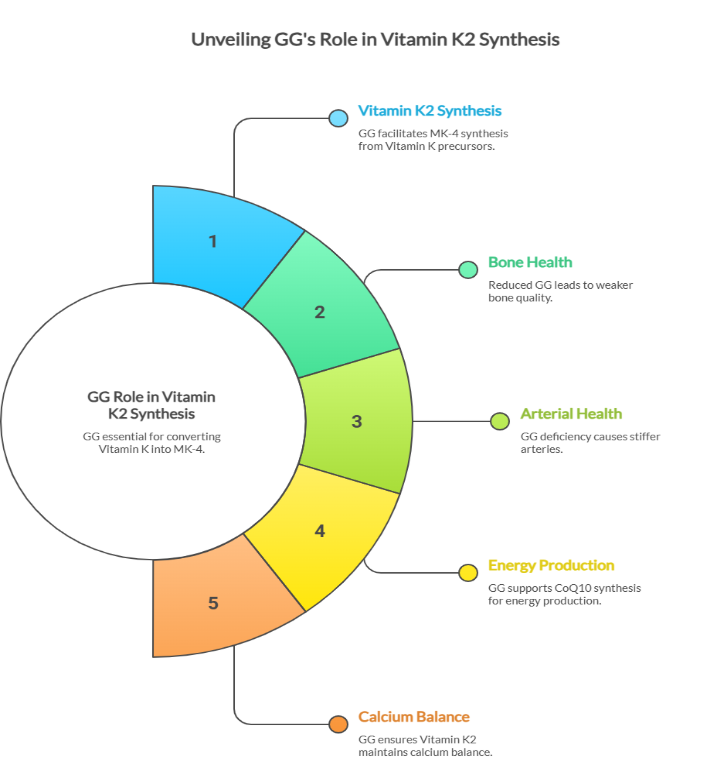
- This critical conversion depends on GG, which becomes geranylgeranyl pyrophosphate (GGPP) inside cells. GGPP provides the prenyl side chain that is attached to Vitamin K intermediates, forming MK-4. Without GG, Vitamin K cannot be transformed into its most active form.(7,8)
- In deficiency or under statin therapy: GG synthesis drops, leading to reduced MK-4, weaker bone quality, and stiffer arteries. This means GG is not only vital for CoQ10 synthesis but also for ensuring Vitamin K2 can do its job.(9)
- Together, they safeguard two fundamental systems:
- Energy production (CoQ10, mitochondria)
- Calcium balance (Vitamin K2, bones & vessels)
In short, GG is the molecular “spark” that switches on Vitamin K2’s protective power.
Conclusion
Geranylgeraniol (GG) acts as a hidden power switch behind two of the body’s most vital pathways. By fueling the conversion of Vitamin K into MK-4, GG helps bones stay strong and arteries stay flexible. At the same time, it drives the body’s own production of CoQ10, keeping mitochondria buzzing with energy. In short, GG is the quiet connector—linking calcium balance and cellular energy—two cornerstones of long-term health.
Key Takeaways
- Dietary CoQ10 is extremely limited (3–5 mg/day) and cannot match clinically effective levels (100–300 mg/day).
- Aging reduces CoQ10 stores by 17–83%, especially in high-energy organs like the heart, brain, liver, and kidneys. CoQ10 supports skin health by improving elasticity and reducing wrinkles.
- Geranylgeraniol (GG) enhances CoQ10 effectiveness by improving cellular uptake and supporting endogenous synthesis.
- Vitamin K2 activates essential Gla-proteins that help deposit calcium into bones and prevent arterial calcification.
- Low GG (ageing, statins, metabolic stress) means low MK-4, leading to weaker bones and stiffer arteries.Together, GG and K2 work synergestically to support mitochondrial energy, calcium balance, and healthy aging.
FAQ’s
Yes, your body makes CoQ10 naturally through the mevalonate pathway, but production
declines with age, stress, and statin use, often leaving levels insufficient for optimal health.
People over 40, those taking statins, or individuals with heart conditions, fatigue, or fertility concerns may benefit from added CoQ10 support.
CoQ10 is generally safe up to about 1,200 mg per day, though most clinical studies use 100–300 mg daily; higher doses should only be taken under medical supervision.
K1 mainly helps with blood clotting. K2 (especially MK-4 and MK-7) directs calcium into bones and away from arteries, making it more important for long-term skeletal health.
Yes. Clinical studies suggest Vitamin K2 (MK-4 or MK-7) is safe, even at higher doses, and does not increase blood clotting risk in healthy people.
References
1. Chin KY. Potential role of geranylgeraniol in managing statin-associated muscle symptoms: a COVID-19 related perspective. PMC. 2023. PubMed Central+1
2. Yubero-Serrano EM, et al. Coenzyme Q10: From bench to clinic in aging. Biochem Pharmacol. 2011;82(9):1113-1126. doi:10.1016/j.bcp.2011.06.005
3.Rodick TC, Seibels DR, Babu JR, Huggins KW, Ren G, Mathews ST. Potential role of coenzyme Q10 in health and disease conditions. Nutrition & Dietary Supplements. 2018;10:1-11. doi:10.2147/NDS.S112119
4. Sale ST, Parvez H, Yeltiwar RRK, Vivekanandan G, Pundir AJ, Jain P. A comparative evaluation of topical and intrasulcular application of coenzyme Q10 (Perio Q™) gel in chronic periodontitis patients: A clinical study. J Indian Soc Periodontol. 2014;18(4):461-465. doi:10.4103/0972-124X.138690. PMID: 25210260; PMCID: PMC4158587.
5.Kumar A, Kaur H, Devi P, Mohan V. Role of coenzyme Q10 (CoQ10) in cardiac disease, hypertension and Meniere-like syndrome. Pharmacological Reports. 2022;74(3):602-614. doi:10.1007/s43440-021-00327-0
6.Paul C, Brady DM, Tan B. Geranylgeraniol boosts endogenous synthesis of coenzyme Q10 and cell essential metabolites, overcoming CoQ10 supplementation limitations. Townsend Letter. April 2021;(453). https://townsendletter.com/geranylgeraniol-boosts-endogenous-synthesis-of-cq10-paul-et-al/
7.Tan J, et al. Revisiting the interconnection between lipids and vitamin K: The prenyltransferase UBIAD1 is the target of geranylgeraniol. PMC. 2024. PubMed Central
8. Shearer MJ, Newman P. Metabolism and cell biology of vitamin K. Thromb Haemost. 2008;100(4):530-547. doi:10.1160/TH08-03-0147
9. Hiruma Y, Nakahama K, Fujita H, Morita I. Vitamin K₂ and geranylgeraniol, its side-chain component, inhibited osteoclast formation in a different manner. Biochem Biophys Res Commun. 2004;314(1):24-30. doi:10.1016/j.bbrc.2003.12.051. PMID:14715241.