
TL;DR
GGPP is your body’s hidden energy link powering cells, hormones, and muscle strength. As levels drop with age or stress, fatigue sets in. Its natural ally, Geranylgeraniol (GG), helps refill this energy pathway, restoring vitality, balance, and resilience from within so that you can feel strong, active, and youthful every day.
Are you feeling fatigued, sluggish, or noticing your muscles don’t recover like they used to? These might be subtle signals that your body’s energy-making machinery is slowing down, and at the heart of this process lies a molecule called Geranylgeranyl Pyrophosphate (GGPP).
Even more fascinating is that your body can also make GGPP from a natural nutrient called Geranylgeraniol (GG), found in certain plants and is also available as a supplement.
Let’s break down how GGPP is made, what it does, and why GG is becoming a key focus in the world of energy and longevity science.
What is geranylgeranyl pyrophosphate?
- Geranylgeranyl Pyrophosphate (GGPP) is a vital intermediate molecule in the mevalonate pathway—the same biochemical route that produces cholesterol, Coenzyme Q10 (CoQ10), and Vitamin K2 (MK-4). ¹
- GGPP is a 20-carbon isoprenoid diphosphate compound (chemical formula: C₂₀H₃₆O₇P₂) that functions as a phenyl donor, transferring hydrophobic geranylgeranyl groups to proteins and small molecules, thus allowing them to attach to cell membranes. ²
- In simpler terms, GGPP acts like a molecular connector, helping essential compounds such as CoQ10, vitamin K2 (MK-4), and certain cell-signaling proteins form and function correctly inside the body. ³
How Geranylgeranyl Pyrophosphate is Formed: The Body’s Energy-Building Assembly Line
Wondering how your body creates the tiny molecules that power your cells?
Let’s decode! One of the unsung heroes in this process is GGPP made inside a key biochemical route called the mevalonate pathway.¹
Think of this pathway as an assembly line in your body factory, where simple raw materials are turned into powerful compounds that keep your heart, bones, and mitochondria running smoothly.
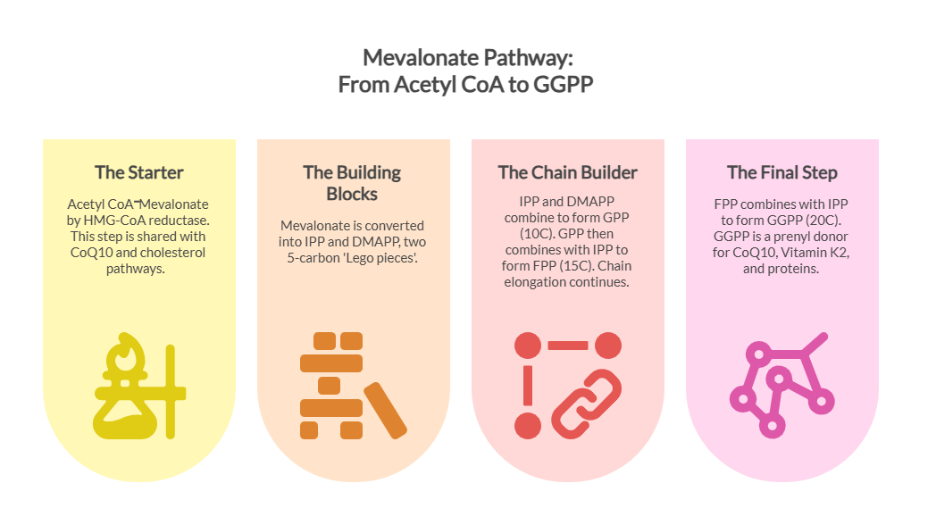
Step-by-Step Journey: From Acetyl-CoA to GGPP
| Step | What Happens | Explanation |
| 1. The Starter – Mevalonate is Born | Acetyl-CoA units (tiny carbon pieces) combine to form mevalonate with the help of an enzyme called HMG-CoA reductase. | This is the same step where cholesterol and CoQ10 pathways also begin — a shared “metabolic highway” |
| 2. The Building Blocks – IPP (Isopentyl pyrophosphate) and DMAPP (Dimethylallyl pyrophosphate) | Mevalonate is converted into two five-carbon bricks called IPP and DMAPP | These are the “Lego pieces” used to build longer chains. |
| 3. The Chain Builder – Geranyl Pyrophosphate (GPP)and Farnesyl Pyrophosphate (FPP) | IPP and DMAPP link up to form GPP, then extend further to make FPP | The chain grows — from 10 to 15 carbons. |
| 4. The Final Step – GGPP (Geranylgeranyl Pyrophosphate) Emerges 4 | One more IPP joins FPP, forming Geranylgeranyl Pyrophosphate (GGPP). | This 20-carbon compound now becomes the “prenyl donor” — a helper that allows your body to make CoQ10, Vitamin K2 (MK-4), and vital proteins. |
Well, call it science or call it magic –GGPP is where your body’s brilliance begins.
And brilliance isn’t just poetic-it’s also functional. GGPP supports several crucial biochemical reactions that drive energy production, cellular production, and healthy ageing.
Let’s discuss the importance of GGPP in detail in the next section.
Why Is GGPP So Important?
Once formed, GGPP acts like a molecular multitool, serving several essential purposes inside your cells:
- Energy Production (CoQ10 Synthesis)
GGPP is a direct building block for Coenzyme Q10 (CoQ10) — the molecule that fuels your mitochondria, the “batteries” of your cells.
Low GGPP = low CoQ10 = poor energy and more oxidative stress .5,6
- Protein Prenylation (Cell Signaling)
GGPP attaches lipid tails to specific proteins (Rho, Rac, Rab GTPases) through a process called prenylation.
This allows those proteins to anchor to cell membranes and send signals that control growth, metabolism, and repair.7
- Muscle and Bone Health
- GGPP is essential for the post-translational modification (geranylgeranylation) of small GTPases such as RhoA, Rac1, and Rab.
- These proteins regulate:
- Muscle cell membrane integrity
- Protein synthesis and degradation
- Mitochondrial trafficking
- Muscle fiber contraction and regeneration
Without enough GGPP, these signaling molecules lose membrane attachment, leading to dysregulated muscle metabolism and weakness.8
Also read: Maximizing Muscle Health: The Role of Geranylgeraniol for Muscle Function
- Hormone Support
The article published, “Role of geranylgeranyl pyrophosphate in steroidogenesis and reproductive cell signaling,” investigates how geranylgeranyl pyrophosphate (GGPP) influences steroid hormone production and intracellular signaling in reproductive cells.
It was observed that blocking GGPP output synthesis reduces steroidogenic enzyme expression, while GGPP restoration normalizes hormone output. 9
It supports:
- Leydig cell function → testosterone biosynthesis
- Granulosa cell signaling → estrogen and progesterone formation
- Prenylation of small GTPases essential for gonadotropin receptor trafficking3
Isn’t it amazing? The same GGPP that powers your cells, also helps to fine-tune your reproductive hormones (molecular regulator)
Do you know?
Men with testosterone below 700 ng/dL showed measurable improvement after GG supplementation, highlighting how restoring GGPP levels may naturally support hormonal vitality
5. Counteracting Statin Side Effects
When statins inhibit HMG-CoA reductase, they lower cholesterol but also reduce GGPP production. This dual depletion may:
- Impair sex hormone synthesis (due to reduced cholesterol pool)10
- Lower CoQ10 (affecting energy in hormone-producing tissues)
- Alter membrane-bound hormone signaling proteins (due to impaired prenylation)
That’s why it is seen that long-term statin use is associated with fatigue, muscle weakness, and sexual hormone imbalance, partly mediated through low GGPP availability.
Also read: Managing Statin Therapy Side Effects—How GG Can Be Your Savior!
An interesting fact is that GGPP prepares the pathway as a precursor, but the moment it transforms to GG, the real functional benefits for the body begin. Let’s discuss GG in the next section.
Geranylgeraniol: The Precursor and Its Health Benefits
What is GG
Geranylgeraniol (GG) is a naturally occurring compound synthesized via the mevalonate pathway, the same route that produces cholesterol, CoQ10, and Vitamin K₂.
Natural origin:
Found in annatto seeds, rice bran, and select fruits, GG is a plant-based compound with an excellent safety record demonstrated in emerging clinical studies.
Mitochondrial & energy support
GG enhances Geranylgeranyl Pyrophosphate (GGPP) synthesis, sustaining mitochondrial energy and CoQ10 production, acting as a key to cellular vitality.
Synergy with CoQ10
When combined with CoQ10 supplements, GG helps optimize energy.
Supports aging and metabolic health:
Supplementation may benefit aging adults, statin users, or those experiencing fatigue, hormonal imbalance, or muscle weakness by helping them sustain overall vitality.11
Read more: Geranylgeraniol Supplements: Everything You Need to Know About GG Gold
GG → GGPP Connection:
GG is the precursor; GGPP is the power.
Together, they drive your body’s core pathways for energy, hormone balance, and Vitamin K₂ (MK-4) activation.
While GG is present in foods like rice bran, the amounts are too small to significantly boost GGPP.
So, supplementation with bioavailable GG forms such as GG-Gold helps maintain healthy GGPP levels, particularly for:
- Adults over 40 experiencing fatigue or muscle weakness
- Individuals on statins or bisphosphonates
- Those with low CoQ10 or hormone imbalance
The synergy between GG and CoQ10 is another emerging topic. When GGPP production drops, CoQ10 synthesis suffers, so supplementing both together may have additive benefits for energy and cardiovascular health.
Conclusion
Every heartbeat and breath depends on energy made inside mitochondria. It acts like the mother of every cell-nurturing, protecting, and powering life from within.
And, the mevalonate pathway is her molecular kitchen, where all essential ingredients are prepared. Among its most precious creations is Geranylgeranyl Pyrophosphate (GGPP), the master ingredient that ties everything together.
GGPP (Geranylgeranyl pyrophosphate) helps the mitochondria produce CoQ10, the molecule that powers energy production, and it activates Vitamin K2 (MK-4), crucial for bone strength and heart health.
Without GGPP, the kitchen runs out of key supplies, leaving the mother unable to fully nourish her cellular family. When this pathway slows down with age or stress, energy, strength, and vitality fade quietly from within.
Supporting your body with GG supplementation means giving your cellular “mother” exactly what she needs, the power to keep nurturing life from the inside out.
Keypoints
- GGPP is an essential molecule for energy, cell signaling, and overall vitality.
- GG is a natural, dietary precursor that helps your body maintain GGPP levels.
- Together, they form a foundation for mitochondrial function, hormonal balance, and tissue repair.
When you support your body with GG, you’re not just taking a supplement; rather, you’re fueling the same pathway that keeps every cell alive, energetic, and resilient.
FAQ’s
GG is the natural nutrient your body converts into GGPP. Think of GG as the seed and GGPP as the tree, GG feeds the body’s energy pathways that support vitality and cellular strength.
GGPP is made inside cells from nutrients like GG found in small amounts in plant oils. Most diets don’t supply enough, making supplementation a practical way to restore balance.
Aging, stress, and statin medications slow down the mevalonate pathway, reducing GGPP and CoQ10 production. This can cause fatigue, muscle weakness, and slower recovery. Supporting this pathway with GG helps restore balance naturally.
Most studies and clinical formulations suggest 150–300 mg of GG per day, depending on individual needs
Absolutely! GG and CoQ10 work synergistically as GG enhances your body’s ability to use and maintain CoQ10 levels, amplifying energy and endurance benefits.
References
- Goldstein JL, Brown MS. Regulation of the mevalonate pathway. Nature. 1990;343(6257):425-430. doi:10.1038/343425a0
- Garza RM, Tran PN, Hampton RY. Geranylgeranyl pyrophosphate is a potent regulator of HRD-dependent 3-Hydroxy-3-methylglutaryl-CoA reductase degradation in yeast. J Biol Chem. 2009;284(51):35368–35380. doi:10.1074/jbc.M109.023994.
- Yang G, Xu J, Qian X, Chen M, Zhou X, Wang L, Liang Y. Geranylgeranyl diphosphate synthase: Role in human health, disease and potential therapeutic target. Pharmacol Res. 2023;189:106680. doi:10.1016/j.phrs.2022.106680
- BioCyc. Superpathway of geranylgeranyldiphosphate biosynthesis I (via mevalonate) [PWY-5910]. BioCyc. Updated May 18, 2022. Accessed December 5, 2025.
- Zhu Y, Lu W, Ye L, Chen Z, Hu W, Wang C, Chen J, Yu H. Enhanced synthesis of Coenzyme Q10 by reducing the competitive production of carotenoids in Rhodobacter sphaeroides. Biochem Eng J. 2017;125:50-55. doi:10.1016/j.bej.2017.03.019
- Bentinger M, Tekle M, Dallner G. Coenzyme Q—biosynthesis and functions. Biochem Biophys Res Commun. 2010;396(1):74-79. doi:10.1016/j.bbrc.2010.02.147
- Xu N, Shen N, Wang XX, Jiang S, Xue B, Li CJ. Protein prenylation and human diseases: a balance of protein farnesylation and geranylgeranylation. Sci China Life Sci. 2015;58(4):328-335. doi:10.1007/s11427-015-4836-1.
- Tao W, Wu J, Xie BX, et al. Lipid-induced muscle insulin resistance is mediated by GGPPS via modulation of the RhoA/Rho kinase signaling pathway. J Biol Chem. 2015;290(33):20086-20097. doi:10.1074/jbc.M115.657742. PMCID: PMC4536415. PMID: 26112408.
- Katsumata S, et al. Role of geranylgeranyl pyrophosphate in steroidogenesis and reproductive cell signaling. Endocrinology. 2012;153(9):4306-4318.
- Istvan ES, Deisenhofer J. Structural mechanism for statin inhibition of HMG-CoA reductase. Science. 2001;292(5519):1160-1164. doi:10.1126/science.1059344
- MuseChem. The Science of Geranylgeraniol: Why It Matters for Your Health. Published March 13, 2025. Accessed December 6, 2025.