TL/DR:
Calcium homeostasis keeps calcium levels stable, while bone mineralization builds strong bones by depositing minerals. When this balance is disturbed, bone cells weaken. Geranylgeraniol (GG) supports calcium-dependent signaling in bone cells, promoting healthy bone mineralization.
Your bones may seem still, but they’re some of the busiest tissues in your body, constantly breaking old cells and rebuilding new strength. And the quiet force directing this cycle is calcium homeostasis, which is the body’s way of regulating calcium. If this balance is disrupted, the bone-building and remodeling process can weaken over time.
Well, the exciting part? Emerging Science points to new nutritional allies, and GG is becoming one of them, gaining attention for its role in keeping mineral balance and bone remodeling on track.
Let’s now dive into how calcium homeostasis really works, what shapes the bone-building process, and why GG is becoming a rising star in bone health research.
What is Calcium Homeostasis?
- Calcium homeostasis is the body’s way of keeping blood calcium levels stable in blood and tissues (around 10 mg/dL) so that muscles, nerves, and bones can function properly. To maintain this balance, the body uses three key hormones.(1)
The Calcium Booster-Parathyroid Hormone
- Parathyroid hormone is released from small parathyroid glands located just behind the thyroid gland in the neck.
- It is released when the blood calcium level drops.
- It signals osteoclasts (bone-resorbing cells) to break down bone and release stored calcium into the bloodstream.
The Absorption Expert-Vitamin D(Calcitriol)
- Vitamin D begins its activation in the liver and completes it in the kidney.
- It increases calcium absorption from the digestive system.
- It helps in the deposition of calcium and phosphate into bones, making them strong.
- It is crucial for preventing deficiency, thereby supporting healthy bone mineralization.
The Calcium Regulator—Calcitonin
- Calcitonin is formed in the thyroid gland, specifically by the tiny C-cells that regulate calcium levels.
- It is released when blood calcium levels rise.
- It slows down osteoclasts, reducing bone resorption (bone breakdown) and guides osteoblasts (bone-forming cells) to build new bones.
- Helps remove excess calcium by increasing urinary excretion (2).
Parathyroid Hormone vs Calcitonin
PTH increases calcium availability while calcitonin decreases its balance.
To understand the full picture, it is essential to understand how these hormones interact with the organs responsible for calcium regulation. Let’s explore the other players that step in to maintain calcium homeostasis.
Also Read: Beyond Calcium: How Geranylgeraniol Could Be the Game-Changer in Your Bone Health Routine?
Key Organs and Hormones That Keep Calcium in Balance
Calcium Balance is a well-orchestrated team effort involving the intestine, kidneys, bones and parathyroid glands guided by powerful hormones and Calcium-sensing receptors (CaSR). Let’s understand each player individually.
1. Bone—The Calcium Reservoir
- Around 99% of the body’s calcium is stored in bones and teeth in the form of calcium phosphate (hydroxyapatite).
- When dietary intake of calcium is low, parathyroid hormone and vitamin D (calcitriol) increase bone resorption.
- They act partly through the RANKL/OPG system to stimulate osteoclast activity and release calcium.
RANKL (Receptor Activator of Nuclear Factor-kB ligand) acts as an accelerator for bone resorption, whereas OPG (Osteoprotegerin) acts as a brake.
2. Intestine-The Entry Gate for Dietary Calcium
- Most of the dietary calcium is absorbed in the small intestine.
- Calcium enters the body by two main routes:
- Transcellular (active) transport – when the body requires calcium, Vitamin D pulls calcium through the intestinal cells using special channels (TRPV6) and proteins.
- Paracellular (passive) transport – when there is a bulk of calcium available, it moves between cells through tight junctions into the bloodstream.
- This system allows the body to adapt to low or high calcium intake by adjusting the amount based on needs. (1,3)
- 1,25-dihydroxyvitamin D₃ (active vitamin D) upregulates intestinal calcium transport proteins, boosting absorption at the time of requirement.
- Low vitamin D levels reduce absorption, forcing the body to rely more on bone calcium.
3. Kidneys-Where Calcium is sorted, saved and kept in Balance
- The kidneys continuously filter calcium, precisely regulate how much needs to be resorbed or excreted.
- Most of the filtered calcium is reabsorbed in the proximal tubules (the first part of the kidney tube that reabsorbs most useful substances), with fine-tuning in other segments of the nephron.
- Transporters like TRPV5 and calbindin help move calcium back into the bloodstream.(3)
Do you know?
Estrogen supports proteins that control calcium flow. After menopause, declining estrogen leaves these proteins with less support. This disrupts healthy bones and mineral balance.
4. The Parathyroid Glands & CaSR-The Calcium Sensor and Control Centre
- The parathyroid glands constantly monitor blood calcium through the calcium-sensing receptor (CaSR) on their cells.
- When blood calcium drops, CaSR signals lead to increased PTH secretion.
- When calcium levels rise, CaSR activation helps suppress PTH and can influence calcitonin release from thyroid C-cells. (1,3)
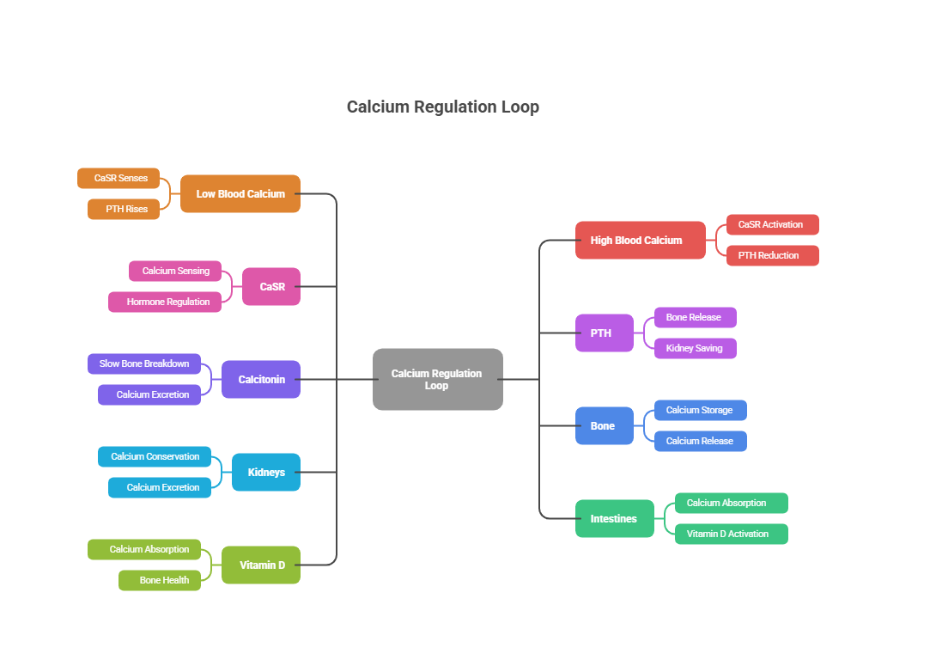
With the calcium-regulation loop in place, the body ensures a steady supply of calcium in the blood. Let’s discuss how this calcium is actually laid down into bone through mineralization.
Bone Mineralization: The Science of Making Strong Bones
Bone mineralization is the biological process of converting soft collagen matrix into a strong, rigid structure capable of supporting the body and resisting fractures. It is essential for skeletal strength, posture, and mobility throughout life. (1)
Key Components of Bone
Bone consists of both organic and inorganic elements.
| Component | Description | Purpose |
| Collagen (Type I) | Protein scaffold | Provides flexibility and tensile strength |
| Hydroxyapatite | Mineral crystals | Provides hardness and compression resistance |
| Osteoblasts | Bone-forming cells | Build collagen matrix & promote mineral deposition |
| Osteoclasts | Bone-resorbing cells | Clear old bone & release calcium |
| Osteocytes | Mechanosensing cells | Regulate turnover and mineralization |
Together, collagen and hydroxyapatite help in making bone strong, resilient, thereby preventing everyday fractures. Now, let’s understand the mineralization process step by step.
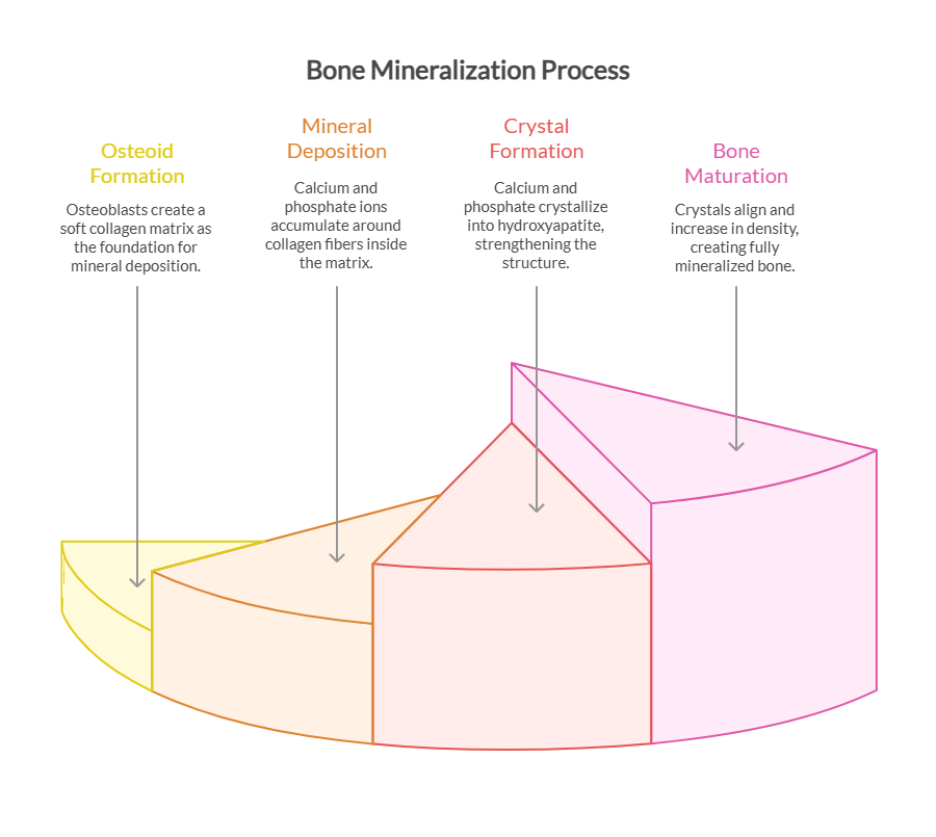
The above steps work beautifully in a healthy body. But with age, the bone mineralization process begins to lose efficiency,acting as the root cause for many health issues.
Age-Related Decline in Mineralization
- With aging, especially after menopause, mineralization declines due to low estrogen levels (increasd resorption).
- Reduced Vitamin D synthesis from sunlight causes
- Less dietary calcium absorption
- Reduced mechanical loading (sedentary lifestyle)
- Increased oxidative stress
- These changes increase the risk of osteopenia and osteoporosis
- It is seen that even early-stage bone loss can significantly elevate fracture risk.(4)
Findings from the National Osteoporosis Risk Assessment (NORA) show that:(4)
Osteopenia increases fracture risk by approximately 1.8X compared to normal BMD Osteoporosis increases fracture risk nearly 4X
Recent data from North America shows that among adults aged 50 and above, 12.6% are already living with osteoporosis and 43.1% have low bone mass, putting nearly half of this population at risk for fractures.(4)
As mineralization efficiency declines with age, the body’s bone-building cells require stronger biochemical support. Geranylgeraniol (GG) is a key molecule in this space. Let’s discuss in the next section.
Understanding Geranylgeraniol (GG)
- Geranylgeraniol (GG) is a naturally occurring isoprenoid synthesized in the body via the mevalonate pathway, the same metabolic route that produces cholesterol derivatives and essential signaling molecules. (5)
- As a dietary compound, GG is found in small amounts in certain oils and plant-based foods, although dietary intake alone may be insufficient for therapeutic effects.
Also Read: GG and Bone health-All you need to know about connection
How GG Supports Bone Structure & Strength
- GG plays a key role in osteoblast differentiation and function. In laboratory studies with human bone cells, GG restored prenylation (a molecular “switch” for cell-signaling proteins) and rescued osteoblast differentiation, and mineralization even under conditions that suppress bone-building.(6,7)
- GG activates small GTPase proteins that help osteoblasts build and strengthen new bones more effectively.(7)
- Moreover, GG influences the expression of genes related to bone formation and calcium regulation.
- GG may restore bone-cell activity when suppressed by medications like bisphosphonates or statins, aging-related decline, or metabolic inflammation.(8)
The GG –Vitamin K2 Connection in Bone Mineralization
To build strong, well-mineralized bones, GG and vitamin K2 work together.
- Vitamin K1 from foods can be converted inside the body into vitamin K2 (MK-4), which is the active form of vitamin K used by bones and blood vessels. This conversion needs GG. When GG levels are low, less MK-4 is produced in bone tissue.
- MK-4 activates important bone proteins (osteocalcin and matrix Gla proteins). These proteins help lock calcium into the bone matrix and prevent it from settling in the arteries.
Together, GG and vitamin K2 (MK-4) help guide calcium into bones, supporting stronger, well-mineralized bones and better overall skeletal health.(9)
Also read: Unveiling the Powerful Connection of Geranylgeraniol and Bone Health
Conclusion
Bone’s health is not just a matter of ageing; it is a matter of proactive care. By understanding calcium homeostasis and embracing nutrients like GG, Vitamin D, and Vitamin K2, along with weight-bearing exercise and sunlight, we can create a lifestyle where bones stay resilient for decades, not just years.
As research evolves, molecules like Geranylgeraniol (GG) offer new possibilities for improving mineralization and restoring balance where the body needs support. Nevertheless, to believe that healthy aging is not luck, it’s a strategy. And the decisions we make today can shape how confidently and independently we move tomorrow.
Key Takeaways
- Mineralization requires coordinated activity between collagen matrix production and hydroxyapatite deposition.
- Ageing, menopause, low Vitamin D exposure, sedentary lifestyle, and inflammation disrupt mineralization and accelerate bone loss.
- Even mild bone loss (osteopenia) increases fracture risk (fracture rates are 1.8× higher in osteopenia and 4× higher in osteoporosis.)
- GG supports osteoblasts, restores prenylation signaling, improves mineralization, and helps maintain balance with osteoclasts.
- GG assists in Vitamin K2 (MK-4) production, enabling activation of bone proteins like osteocalcin and MGP, which are crucial for directing calcium into bones.
FAQ’s
With age, estrogen levels decline, which increases bone resorption (breakdown) and reduces the efficiency of calcium mineralization. Combined with reduced Vitamin D synthesis, lower activity, and slower cellular repair, this leads to bone loss and higher fracture risk.
Not always. Calcium needs Vitamin D for absorption, and Vitamin K2 and GG for proper utilization inside bone tissue.
GG is a natural compound produced in the mevalonate pathway. It supports osteoblast function, bone formation, protein signaling (prenylation), and healthy bone turnover.
GG helps convert dietary Vitamin K1 into Vitamin K2 (MK-4), which activates osteocalcin and MGP, proteins that bind calcium to the bone matrix.
Older adults, post-menopausal women, people with statin or bisphosphonate-related muscle/bone effects, sedentary individuals, and those with low Vitamin D or K2 intake can be benefitted from GG supplementation.
References
- Pu F, Chen N, Xue S. Calcium intake, calcium homeostasis and health. Food Sci Hum Wellness. 2016;5(1):8-16. doi:10.1016/j.fshw.2016.01.001.
- Yu E, Sharma S. Physiology, Calcium. StatPearls. Treasure Island, FL: StatPearls Publishing; August 14, 2023.
- Khan MM, Desborough JP. Calcium Homeostasis. Bulletin of the Royal College of Anaesthetists. Reproduced with permission. London: St George’s School of Anaesthesia & Epsom and St Helier NHS Trust.
- Aggarwal N, Raveendran A, Khandelwal N, et al. Prevalence and related risk factors of osteoporosis in peri- and postmenopausal Indian women. J Midlife Health. 2011;2(2):81-85. doi:10.4103/0976-7800.92537.
- Sharma P. The Science of Geranylgeraniol: Why It Matters for Your Health. Wellness Extract Blog. Published March 13, 2025. Pennsylvania, USA.
- Fliefel R, Entekhabi S, Ehrenfeld M, Otto S. Geranylgeraniol (GGOH) as a Mevalonate Pathway Activator in the Rescue of Bone Cells Treated with Zoledronic Acid: An In Vitro Study. Stem Cells Int. 2019;2019:4351327.
- Mungpayabarn H, et al. Timing of geranylgeraniol addition increases osteoblast activities under alendronate condition. J Oral Biol Craniofac Res. 2021;11:396–401.
- Tan B, Chin KY. Potential role of geranylgeraniol in managing statin-associated muscle symptoms: a COVID-19 related perspective. Front Pharmacol. 2021;12:733861. doi:10.3389/fphar.2021.733861.
- Hiruma Y, Nakahama K, Fujita H, Morita I. Vitamin K2 and geranylgeraniol, its side chain component, inhibited osteoclast formation in a different manner. Biochem Biophys Res Commun. 2004;314(1):24-30. doi:10.1016/j.bbrc.2003.12.051.