TL/DR- Resveratrol helped define early anti-aging science through antioxidant signaling, but geranylgeraniol (GG) represents the next evolution. By replenishing key molecules lost with age and statin use, GG supports muscle strength, energy production, and cellular stability at a foundational level.
In the quest for anti-aging supplements, resveratrol has stolen the spotlight for many years, mainly due to its antioxidant properties and red wine allure. Until a revolutionary molecule, “Geranylgeraniol,” stepped in with roles far beyond longevity.
What made it different wasn’t hype, but the level at which it works. Geranylgeraniol supports the body at a deeper level by helping cells stay organized, energized, and responsive. Its influence extends to muscle function, mitochondrial energy function, bone metabolism, and cellular resilience.
This showdown reveals why Geranylgeraniol outperforms Resveratrol by understanding their mechanisms, market presence, and real-world relevance, and explains why GG is emerging as a smarter, next-generation anti-aging agent.
Breaking Down the Players: What Exactly Are Geranylgeraniol and Resveratrol?
GG and Resveratrol are two naturally occurring compounds gaining attention for their roles in cellular aging. Let’s break them down individually to understand their origins and biological roles.
What is Geranylgeraniol?
Geranylgeraniol (GG) is a naturally occurring isoprenoid produced in the body through the mevalonate pathway, the same biochemical pathway involved in the synthesis of cholesterol, Coenzyme Q10(CoQ10), and vitamin K2. (1)
It is also naturally present in annatto, olive oil, rice bran, and whole grains.
GG helps important proteins attach to cell membranes, thereby enabling cells to repair muscle tissue, transport nutrients, maintain strong bones, and produce energy efficiently.
The body can produce geranylgeraniol on its own.
However, the natural production of GG may decline with age or metabolic stress. To support consistent intake, GG used in supplements is typically obtained from a plant source, “Annatto.”
Do You Know!
Annatto seeds (Bixa orellana) are considered the richest source of Geranylgeraniol as they contain 1-5 percent GG by weight, which is drastically higher than any other plant. (2)
What is Resveratrol?
Resveratrol is a plant-based polyphenol found in foods like grapes, berries, peanuts, and dark chocolate. It is produced by plants as a natural defence against environmental stress, which is why it’s often described as an antioxidant. (3)
- Resveratrol’s popularity surged due to its presence in red wine and its activation of SIRT1, a pathway linked to the effects of calorie restriction.
- It activates cellular processes associated with healthy aging, including improved energy regulation, cellular cleanup (autophagy), DNA protection, and better control of inflammation through the body’s own antioxidant enzyme. (4)
- This indirect signaling protects heart and brain health by reducing oxidative stress, as it supports the body exogenously.
However, its low bioavailability (<2%), often necessitates higher doses, which may contribute to inconsistent results in human studies, despite promising animal data.(5)
While both these molecules are studied for healthy aging, their biological roles differ markedly: one focuses on cellular signaling (Resveratrol), the other on cellular restoration (GG).
Mechanism of Action of Resveratrol and Geranylgeraniol
Both resveratrol and GG support cellular health, but they act through distinct biological mechanisms.
Resveratrol primarily works by activating stress-response and energy-regulation pathways, including SIRT1 and AMPK signaling, which enhance mitochondrial function, antioxidant defenses, and metabolic adaptation.(6)
In contrast, geranylgeraniol supports core cellular metabolism by replenishing mevalonate pathway intermediates after conversion to geranylgeranyl pyrophosphate (GGPP). This process helps in maintaining cellular signaling and energy production.(7)
However, natural production of GG and GGPP may decline with age or metabolic stress. To support consistent intake, GG used in supplements is typically obtained from a plant source, “Annatto”(8)
The table below outlines their mechanisms in detail.
| Feature | Geranylgeraniol (GG) | Resveratrol |
| Type of action | Structural & restorative | Signaling & adaptive |
| Main pathway | Mevalonate pathway | SIRT1 → AMPK pathway |
| Key conversion | Converted into GGPP | Not converted into cellular building blocks |
| Role in aging | Helps replace molecules that naturally decline with age | Helps cells respond better to aging-related stress |
| Antioxidant support | Supports the body’s internal balance that controls oxidative stress | Activates antioxidant enzymes indirectly |
| Effect of statins | Replenishes molecules reduced by statin use | Not directly affected by statins |
| Bioavailability | Naturally used by cells once absorbed | Very low absorption in active form |
| Cellular feature | Supports cellular resilience. | Supports stress response. |
Resveratrol signals protection; Geranylgeraniol supplies restoration.
Clearly, positioning Geranylgeraniol as a more comprehensive ally for long-term cellular aging support.
Head-To-Head Comparison: Geranylgeraniol (GG) vs Resveratrol
Before choosing a better molecule, it is important to ask a simple question: what kind of help do your cells need as you age? Well, GG and resveratrol address this question in their own different ways:
One rebuilds the cellular hardware when statins wear down (GG); the other fine-tunes the software that regulates stress responses and repair (Resveratrol). That’s where a true head‑to‑head comparison becomes a revealing and deciding factor.
Let’s summarize the Comparative Features in a table below:
| Feature | Geranylgeraniol (GG) | Resveratrol |
| Primary Role | Cellular building block(10) | Cellular signaling molecule |
| Protein Prenylation | Restores (membrane anchoring) | No effect |
| Muscle Support(7) | Direct repair/strength | Indirect, limited |
| Bone Remodeling | Balances signaling | Minimal |
| Mitochondrial Energy | CoQ10 building blocks → ATP | Efficiency signaling |
| Hormones | Steroidogenesis (testosterone) | No effect |
| Statin Effect | Replaces depletions | Doesn’t address |
| Consistency of Benefits | More predictable (pathway-level supply) | Highly variable (dose & formulation dependent) |
| Typical Daily Dose (9,10) | ~150 mg/day (clinical range: 150–300 mg, annatto-derived) | 100–500 mg/day (often needs enhanced forms) |
| Dosage Sensitivity | Linear, supportive effects | Biphasic: low-dose benefit, high-dose risk |
| Safety Profile | Endogenous compound supporting normal physiology | Generally safe at low doses; high doses linked to GI distress, organ stress, and adverse effects in some models |
| Bioavailability | Excellent | Poor (<2%) |
| Action Type | Structural/restorative | Protective/adaptive |
| Aging Strategy | Rebuilds foundations | Helps cope with stress |
Geranylgeraniol (GG) provides foundational, pathway-level support by restoring essential cellular building blocks, enhancing muscle, bone, mitochondrial energy, and hormonal function with predictable, bioavailable effects.
In contrast, resveratrol mainly offers indirect signaling benefits with variable outcomes, making GG the stronger and more structurally restorative strategy for healthy aging.These functional differences are reflected in research findings, outlined below:
Clinical and Preclinical Evidence: GG and Resveratrol Comparison
Let’s take a look at what the research actually shows. The tables below summarize key preclinical and human studies on geranylgeraniol (GG) and resveratrol, highlighting their mechanisms, dosing regimens, and clinical outcomes.
A. Evidence Supporting Geranylgeraniol (GG)
| Study / Year | Design | N | Population / Model | Dose | Duration | Key Result |
| Cao et al., 2009(11) | In vitro and animal | — | Statin-treated muscle cells & rodents | GG supplementation | 2–4 weeks | GG fully reversed statin-induced muscle fiber loss by restoring protein prenylation |
| Irwin et al., 2020(12) | In vivo | — | Rodent statin-fatigue model | Oral GG | 4 weeks | Prevented muscle fatigue and improved force production |
| Miyawaki et al., 2020(13) | In vivo | — | Denervation-induced atrophy (rodents) | GG | 14 days | Preserved muscle mass and fiber size |
| Jiwan et al., 2022(14) | In vivo | — | Diabetic skeletal muscle degeneration | Oral GG | 8 weeks | Improved mitochondrial quality, reduced muscle degeneration |
| Human pilot (Annatto-GG)(15) | Human | Small cohort | Adults with low baseline GGPP | 150–300 mg/day | 8–12 weeks | ↑ Muscle force (~30–35%) and ↑ testosterone (7–15%) in low-baseline individuals |
Evidence consistently shows that geranylgeraniol plays a restorative, pathway-level role in muscle and cellular health. In vitro, animal, and early human studies indicate that GG can counter statin-related muscle dysfunction, support mitochondrial integrity, and preserve lean mass by replenishing GGPP and restoring protein prenylation.
B. Evidence Supporting Resveratrol
| Study / Year | Design | N | Population / Model | Dose | Duration | Key Result |
| Zhang et al., 2021(4) | Review | — | Human + animal | Various | — | Resveratrol activates SIRT1/AMPK/PGC-1α but shows low bioavailability and inconsistent clinical outcomes |
| Salehi et al., 2018(10) | Review | — | Human + animal | 100 mg–5 g/day | Acute–long term | Biphasic effects: low doses protective; high doses linked to GI, liver, kidney toxicity |
| Wilson et al., 2016(16) | Animal | — | Hypercholesterolemic rabbits | 1 mg/kg | 12 weeks | Resveratrol unexpectedly worsened atherosclerosis |
| Ferry-Dumazet et al., 2018(17) | Animal | — | Rats | 3000 mg/kg | 28 days | High-dose resveratrol caused nephrotoxicity |
| Human PK studies (18) | Human | — | Healthy adults | Up to 5 g/day | Short term | Safe short term but <2% active bioavailability; GI effects common |
Resveratrol research has primarily been conducted on cells and animals, focusing on stress-response and antioxidant pathways. However, in humans, results are inconsistent due to less absorption and variable doses. In contrast, Geranylgeraniol (GG), although less studied, provides early human evidence of measurable benefits by directly restoring important cellular components that decline with age or statin use.
These findings provide a scientific basis for Geranylgeraniol’s growing importance and are now featured in next-generation wellness formulations.
Let’s take a look at how GG is quietly redefining the market dynamics, once dominated by Resveratrol.
Market Perspective: Popular or Purposeful
- Resveratrol enjoys established popularity through wide availability and heavy marketing as a general antioxidant, appealing to broad wellness seekers.
- Resveratrol commands an established market valued at ~USD 80–140 million in 2024–25, with steady multi-percent CAGR (Compound Annual Growth Rate) driven by broad anti-aging appeal.
- GG remains nascent and niche as market size hit USD 218.7 million for GG-Gold variants in 2024, but shows explosive upside from specialized brands like Wellness Extract GG Gold, and annatto extracts targeting statin users and muscle health(19)
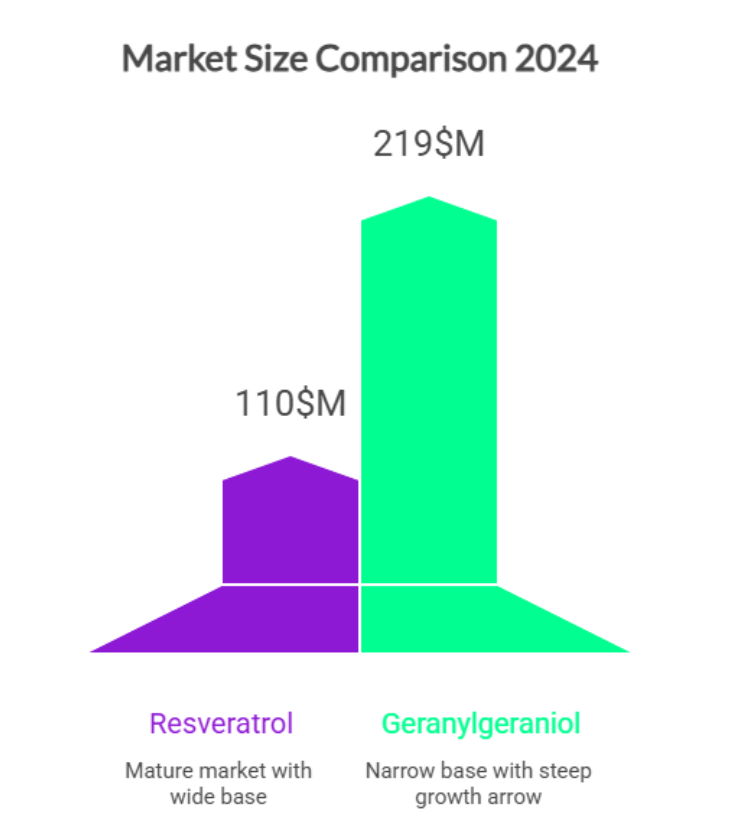
Market Size Comparison 2024
Resveratrol shows a larger, mature market built on broad awareness, while GG’s smaller base reflects a focused, fast-rising category driven by targeted clinical use cases.
It is clear that although Resveratrol is quite popular, GG stands out as a purpose-built ingredient, marketed around real physiological needs rather than broad antioxidant hype.
Let’s summarize:
| Feature | Resveratrol | Geranylgeraniol (GG) |
| Market positioning | Mass-marketed | Niche but emerging |
| Core narrative | Strong antioxidant & longevity buzz | Purpose-driven, pathway-focused |
| Brand landscape | Many brands, crowded category | Fewer brands, clearer differentiation |
| Consumer awareness | High | Low but rapidly growing |
| Primary benefit framing | “Longevity signaling” | Cellular restoration & resilience |
| Marketing style | Hype-led, trend-driven | Science-led, need-based |
| Competitive advantage | Familiarity | Precision and relevance |
| Long-term positioning | Saturated | High-upside, targeted growth |
Conclusion
Geranylgeraniol (GG) emerges as the undisputed hero in anti-aging supplements, outshining resveratrol by directly replenishing vital mevalonate pathway components depleted by statins and age.
For years, longevity research has focused on activating protective pathways. The emerging insight is clear: Cells must first be rebuilt before they can respond. This shift reframes the conversation from resveratrol’s signaling to geranylgeraniol’s restorative role.
While resveratrol relies on mass-market scale from generic suppliers, GG thrives through specialized brands such as Wellness Extract, positioning it in clinical niches like SAMS recovery for premium pricing and loyalty among statin users despite smaller volume.
Key Takeaways-Why Geranylgeraniol is a Hero
- Restores downstream mevalonate products (GGPP/CoQ10) that are depleted with age or statin use. Hence, it acts as a targeted mechanism, not just antioxidant.
- Direct links to muscle & bone support in preclinical models and early human work.
- Clinically positioned products and registered studies (credibility signal).
- Easier pairing with CoQ10 and vitamin K2 for logical synergy.
- Lower consumer hype and clearer mechanistic niche (less overpromising than resveratrol).
FAQs
GG restores essential cellular building blocks, while resveratrol mainly activates protective signaling pathways.
Only a small fraction of orally consumed resveratrol is absorbed in circulation in active form, making results highly dose- and formulation-dependent.
GG is preferable because it offers a more targeted, practical approach, whereas resveratrol remains a supportive antioxidant signaler.
Adults experiencing age-related muscle or energy decline, individuals under metabolic stress, and those using statins may benefit most.
Most GG supplements provide ~150 mg per day, with clinical and market ranges commonly between 150–300 mg/day.
References
- Casarett & Doull’s Chemical Information Service (CASI). Geranylgeraniol. https://www.casi.org/node/1060. Accessed September 13, 2025.
- Preston HD, Rickard MD. Extraction and chemistry of annatto. Food Chem. 1980;5(1):47–56. doi:10.1016/0308-8146(80)90063-1.
- Hill K. Health benefits of resveratrol. Verywell Health. Updated December 14, 2025. Medically reviewed by Cervoni B, RD. Accessed
- Zhang LX, Li CX, Kakar MU, et al. Resveratrol (RV): a pharmacological review and call for further research. Biomedicine & Pharmacotherapy. 2021;143:112164. doi:10.1016/j.biopha.2021.112164
- Jolly S, Tawfik D, Bakhshi S. Resveratrol and aging: a comprehensive review of longevity claims and scientific findings. Published June 8, 2024.
- Constantinescu T, Mihis AG. Resveratrol as a privileged molecule with antioxidant activity. Food Chemistry Advances. 2023;2:100539. doi:10.1016/j.focha.2023.100539
- Sharma P. The Mevalonate Pathway: Central Hub of Cholesterol Metabolism, Isoprenoid Biosynthesis, and Disease Mechanisms. Published November 2025. Accessed November 10, 2025
- Preston HD, Rickard MD. Extraction and chemistry of annatto. Food Chem. 1980;5(1):47–56. doi:10.1016/0308-8146(80)90063-1.
- Jennings KA. 7 health benefits of resveratrol supplements. Healthline. Published July 3, 2023
- Salehi B, Mishra AP, Nigam M, et al. Resveratrol: a double-edged sword in health benefits. Biomedicine & Pharmacotherapy. 2018;103:91–100. doi:10.1016/j.biopha.2018.04.013
- Cao P, Hanai J, Tanksale P, et al. Statin-induced muscle damage and atrogin-1 induction is the result of a geranylgeranyl pyrophosphate deficiency. FASEB J. 2009;23(9):2844-2854.
- Irwin J, et al. Geranylgeraniol prevents statin-induced muscle fatigue in rodents. Front Physiol. 2020;11:112.
- Miyawaki H, et al. Geranylgeraniol attenuates denervation-induced muscle atrophy. J Nutr Biochem. 2020;79:108339.
- Jiwan NC, Ghosh S, Mishra S, et al. Geranylgeraniol supplementation improves mitochondrial quality and attenuates skeletal muscle degeneration in diabetic rats. Int J Clin Exp Pathol. 2022;15(2):45-56.
- Gheith R, Irwin C, Heaton J, et al. Effects of geranylgeraniol supplementation on testosterone levels and muscle performance in adults with low baseline GGPP: a pilot clinical study. Biomolecules. 2023;13(4):643. doi:10.3390/biom13040643
- Wilson T, Knight TJ, Beitz DC, Lewis DS, Engen RL. Resveratrol promotes atherosclerosis in hypercholesterolemic rabbits. Life Sci. 2008;82(23-24):1217-1224.
- Ferry-Dumazet H, et al. Nephrotoxicity of high-dose resveratrol in rats. Food Chem Toxicol. 2012;50(3-4):652-659.
- Hiruma Y, Nakahama K, Fujita H, Morita I. Vitamin K2 and geranylgeraniol inhibit osteoclast formation. Biochem Biophys Res Commun. 2004;314(1):24-30.
- More AB. GG-Gold geranylgeraniol market research report 2033. Growth Market Reports. Fact-checked by Chandola V; edited by Bhat S.
Leave a Reply