TL/DR:
Aging happens when DNA damage occurs at a rate that exceeds the repair capacity of cells.. Over time, the systems that power DNA repair weaken. Geranylgeraniol (GG) supports key upstream pathways that maintain mitochondrial energy and protein function, thereby creating a better environment for DNA repair. Instead of directly fixing DNA, GG helps cells maintain their ability to repair themselves.
Aging starts deep inside your cells, often years before you see wrinkles or feel tired.
Every day, DNA sustains thousands of microscopic injuries from normal metabolism, oxidative stress, and environmental exposures such as sunlight. At a younger age, the body corrects everyday damage with ease, maintaining balance and vitality.
Over time, however, these systems lose efficiency. When damage accumulates faster than it can be repaired, cells enter a state of functional decline leading to cellular aging and the gradual loss of tissue resilience.
DNA repair is your body’s built-in renewal system, quietly fixing genetic wear every moment of your life. Supporting this system means supporting the foundations it runs on. Geranylgeraniol (GG) replenishes cellular building blocks, creating a stronger repair environment by simple antioxidant strategies.
Let’s begin by understanding what DNA is and why it matters!
What is DNA?
- DNA (deoxyribonucleic acid) is the molecular blueprint that contains instructions for building, maintaining, and repairing every cell in the human body.
- DNA is a double helix made of two matching strands, where bases pair specifically (guanine with cytosine and adenine with thymine).
- It stores genetic information and is copied each time a cell divides, ensuring every new cell receives the same instructions. These instructions guide protein production, energy generation, and other essential cellular functions.(1)
- DNA is not just a static information archive; its stability under stress ultimately shapes cellular resilience and longevity. Let’s understand now why DNA damage matters.
Why DNA Damage Matters?
At any given moment, DNA damage occurs in each cell, which alters the genetic information that guides cellular function.
If left unrepaired, these alterations can trigger cell death or drive the transformation of healthy cells into diseased ones, including cancer. Estimates suggests that each human cell experiences between 10,000 and one million DNA injuries per day.(2)
These injuries arise from two primary sources:
Exogenous sources (originating from outside): These include ultraviolet and ionizing radiation, environmental toxins, tobacco, dietary toxins, industrial chemicals, viruses, and bacteria.
Endogenous sources (originating within the body): particularly reactive oxygen species (ROS) generated during normal metabolism.These molecules can alter DNA bases, break strands, or distort DNA structure(2)
Because DNA integrity is essential for survival, cells are equipped with multiple DNA repair mechanisms that constantly detect and correct damage. We will discuss them in later section
This constant DNA damage makes one thing very evident: that repair is not optional; it is essential. Let’s understand why it is so significant.
Significance of DNA Repair
The DNA repair system acts as a guardian of cellular health, correcting damage before it disrupts normal function. Insufficient DNA repair, or a weakened DNA damage response (DDR), is strongly linked to a wide range of age-related diseases.
These include:
- Neurodegenerative conditions (such as Alzheimer’s disease)
- Chromosomal instability disorders (such as Cockayne syndrome)
- Monogenic disorders (including ataxia–telangiectasia)
- Cardiovascular disease
- Diabetes
- Cancer
Now that the impact of DNA damage is clear, let’s understand how cells respond to it.
The DNA Damage Response: Cellular Quality Control
Cells are equipped with an integrated system called the DNA Damage Response (DDR). This system:
- Detects DNA lesions
- Pauses cell division
- Activates appropriate repair enzymes
- Determines cell fate if damage is excessive
Upon successful repair, normal cellular function is restored. However, when repair capacity declines, cells may enter senescence (a non-dividing aging state) or undergo programmed cell death.
Over decades, declining DDR efficiency has become a central driver of biological aging. To manage this process, the body deploys multiple regulatory mechanisms.
DNA Repair Mechanisms
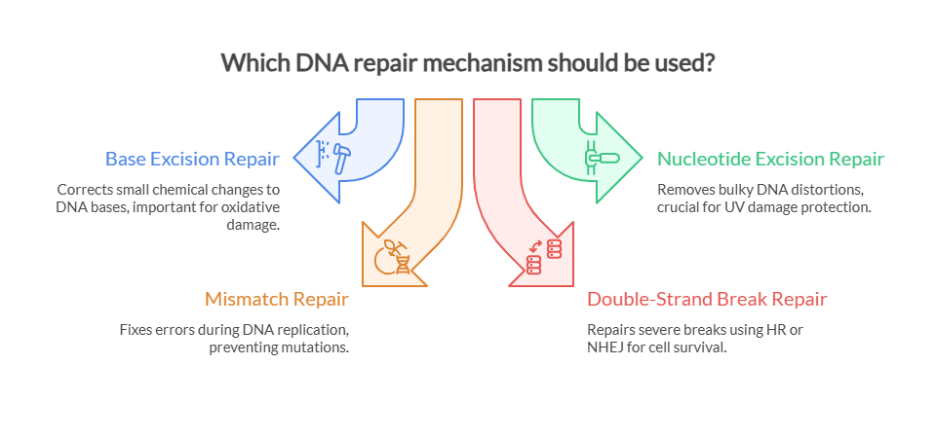
As cells experience many types of DNA damage, the body uses multiple specialized pathways, each optimized to recognize and correct particular forms of genetic injury. Together, these pathways preserve genome stability and support long-term cellular function.
DNA Repair Pathways
| Repair Pathway | Type of Damage Repaired | How It Works |
| Base Excision Repair (BER)(3) | Small, localized chemical base damage caused by oxidative stress and metabolism | Damaged bases are recognized and removed, replaced with the correct base, and sealed by DNA ligase, support healthy aging |
| Nucleotide Excision Repair (NER)(4) | Bulky DNA distortions caused by UV radiation and toxins | Damaged DNA segments are excised and replaced using the healthy strand as a template preventing mutations. |
| Mismatch Repair (MMR)(5) | Replication errors during DNA copying | Detects and corrects incorrect base pairings formed during cell division |
| Double-Strand Break Repair(6) | Breaks affecting both DNA strands | Repaired through homologous recombination or non-homologous end joining |
Why DNA Repair Declines with Age?
As we age, the cellular environment that supports DNA repair gradually weakens.
DNA repair is an energy-intensive, tightly regulated process, and several age-related biological shifts reduce the cell’s ability to detect and fix damage efficiently.
Below is a summary table with the key age-related factors that effects DNA repair:
Aging-Related Factors That Impair DNA Repair
| Factor | Molecular Effect on DNA Integrity | Impact on DNA Repair & Aging | Prevalence / Relevance |
| Mitochondrial dysfunction(7) | Increased ROS production damages mitochondrial and nuclear DNA | Higher oxidative lesion burden accelerates senescence | Increases progressively with age |
| Declining endogenous CoQ10(8) | Reduced electron transport efficiency → more ROS and more oxidative stress | Lowers ATP supply required for repair enzymes | CoQ10 levels fall with aging |
| Telomere shortening | Chromosome end instability | Activates DDR and replicative senescence | Universal with aging |
| Reduced NAD⁺ availability (9) | Impaired PARP-1 enzyme and sirtuin activity | Slower damage sensing and repair signaling | Declines with aging |
| Chronic inflammation (1) | ROS- and cytokine-mediated DNA lesions | Disrupts repair coordination | Common in older adults |
| Statin-mediated mevalonate inhibition(10) | Decreased GG and CoQ10 synthesis | Weakened mitochondrial function and protein prenylation | ~35 million US users |
| Accumulated oxidative stress(11) | Base modifications and strand breaks³ | Overloads pathways | Increases with age |
The above-mentioned factors show that aging does not impair DNA repair through a single pathway. Instead, it weakens the foundational metabolic systems such as energy production, NAD⁺ availability, and mitochondrial integrity on which the repair machinery depends on.
So, rather than targeting individual lesions, a more effective strategy may be to support these upstream metabolic pathways that sustain the cell’s repair environment.
This is precisely where geranylgeraniol (GG) becomes relevant, as an upstream metabolic building block that helps restore the cellular infrastructure required for efficient DNA repair.
Geranylgeraniol: A Foundational Cellular Building Block
Geranylgeraniol (GG) is a naturally occurring isoprenoid produced endogenously through the mevalonate pathway and found in trace amounts in selective plant sources, including annatto seeds.(12)
GG functions as a critical precursor for several essential cellular processes that influence long-term cellular performance.
Biologically, GG contributes to:
- Protein prenylation (a lipid modification required for proper protein attachment and activity)
- Endogenous coenzyme Q10 (CoQ10) synthesis
- Mitochondrial membrane structure and function(13)
Rather than acting as a single-purpose antioxidant, GG supports multiple foundational systems that collectively shape cellular resilience and DNA repair capacity.
Also Read: GG for Healthy Aging: Why it is Best Natural Support
GG and Mitochondrial Support: Energizing Cellular Repair
GG supports mitochondrial health through two complementary mechanisms:
- Supporting endogenous synthesis of CoQ10, a central component of the electron transport chain.
- Maintaining membrane-associated protein function via prenylation.
When mitochondria operate efficiently, ATP production increases while electron leakage and reactive oxygen species (ROS) generation decrease. This dual effect strengthens repair capacity and reduces the formation of new damaged DNA.
Also Read: Mitochondrial Powerhouse: How GG supplements Support CoQ10 Production for Better Cellular Health
GG and Protein Prenylation: Keeping Repair Proteins Functional
Many intracellular signaling and regulatory proteins must undergo prenylation to attach to cellular membranes and function correctly. GG supplies the geranylgeranyl groups required for this modification.
Insufficient prenylation can lead to:
- Dislocalization of DNA damage sensors (proteins that detect DNA injury and help in repair)
- Impaired stress-response signaling (lower ability of cells to sense or respond to damage)
- Disrupted coordination of repair complexes (repair proteins fail to work efficiently)
By sustaining prenylation capacity, GG helps ensure that proteins involved in cellular maintenance and repair are properly positioned and operational.(14)
GG and Endogenous CoQ10: An Upstream Advantage
CoQ10 supplements provide a ready-made molecule to your body which supports your cells in producing energy.
However, GG works differently. Instead of giving the finished molecule, it provides the raw material that your body needs to make its own CoQ10. At the same time, it also supports other important processes of the mevalonate pathway.(13)
To understand whether this cellular role translates into measurable benefits, it is important to explore the available experimental and clinical research.
Evidence Table — DNA Repair, Aging, and Geranylgeraniol (GG)
| Study | Year | Design | N | Population / Model | Dose | Duration | Key Result |
| Jiwan et al.(17) | 2022 | Animal study | 40 rats | Diabetic rat model | GGOH ~100 mg/kg diet | 8 weeks | GG mitigated muscle atrophy and improved mitochondrial morphology and quality markers. |
| Zhao et al.(19) | 2020 | Mechanistic Review | — | human & cell models | — | — | GG was required for correct localization and function of many signaling proteins essential for intracellular regulation. |
| Jaśkiewicz et al.(16) | 2018 | In-vitro experimental | — | C2C12 mouse myoblasts | Simvastatin/atorvastatin ± GGOH 10 µM | 24 h | GG restored protein prenylation, rescued cell viability, and activated cytoprotective autophagy. |
| Marcuzzi et al.(18) | 2016 | Cell culture study | — | Human neuronal (Daoy) cells | Mevalonate blockade ± GGOH | 24–72 h | GG reduced mitochondrial damage and apoptosis. |
| Thompson et al.(11) | 2016 | Systematic Clinical Review | — | Human statin users | Typical clinical statin doses | Chronic | Statins inhibit mevalonate pathway; associated with muscle symptoms and metabolic side effects linked to depletion of CoQ10 and GG. |
| López-Otín et al.(10) | 2013 | Consensus Review | — | Human & animal aging biology | — | — | Genome instability, mitochondrial dysfunction, telomere attrition, and senescence identified as core hallmarks of aging. |
| Campia et al.(15) | 2009 | In-vitro experimental | — | THP-1 human monocytes | Mevastatin ± GG 10 µM | 24–48 h | GG prevented statin-induced cytotoxicity without reducing cholesterol-lowering effect. |
| Hoeijmakers JHJ(9) | 2009 | Narrative Review | — | Human, animal & cellular aging research | — | — | DNA damage accumulation and defective DNA repair are central drivers of aging and cancer. |
Across cellular, animal, and clinical literature, aging and statin exposure impair the formation of mevalonate pathway intermediates, mitochondrial function, and protein prenylation, whereas GG consistently restores these upstream processes that underlie effective DNA repair.
Conclusion
For decades, aging has been framed as an accumulation of damage. However, modern biology paints a more precise picture: damage is constant across all ages. Rather, what changes is the body’s ability to fix it.
DNA repair lies at the center of this shift. When repair systems are well supported, cells preserve energy and function, thereby resisting premature decline. However, if the metabolic foundations of repair erode, damage accumulates and tissues lose resilience. Aging, therefore, is less a story of destruction and more a story of declining cellular maintenance.
This perspective transforms how longevity strategies should be designed. Instead of relying solely on antioxidants, a more effective approach is to restore the upstream metabolic infrastructure that enables repair to happen.
Geranylgeraniol (GG) represents this next-generation paradigm. By supporting mevalonate-derived processes that sustain mitochondrial energy production, protein prenylation, and endogenous CoQ10 synthesis, GG helps rebuild the cellular environment in which DNA repair machinery operates.
GG does not “fix” DNA. It helps cells regain their capacity to repair themselves, and that distinction may define the future of healthy aging.
Key Takeaways
- Aging is driven less by the amount of DNA damage and more by declining DNA repair capacity.
- DNA repair requires energy, functional proteins, and intact metabolic pathways.
- Mitochondrial dysfunction, low CoQ10, reduced NAD⁺, inflammation, and impaired prenylation all weaken repair efficiency with age.
- GG supports upstream pathways that sustain mitochondrial energy production and protein prenylation.
- GG does not directly repair DNA; it strengthens the cellular environment that enables repair.
- Longevity strategies are shifting from damage suppression toward preservation of cellular maintenance systems.
FAQs
Yes. DNA damage occurs continuously in all cells as a result of normal metabolism and environmental exposure.
No, DNA repair is performed by specialized enzymes. Nutrients and metabolic compounds can support cellular systems that enable these enzymes to function properly.
Antioxidants mainly neutralize free radicals. Geranylgeraniol acts upstream by supporting mitochondrial energy production and protein prenylation.
No. CoQ10 is a downstream mitochondrial cofactor. Geranylgeraniol is an upstream precursor that supports endogenous CoQ10 synthesis while also serving other biological roles.
No. GG complements foundational lifestyle practices such as good nutrition, exercise, sleep, and stress management.
References
- Alberts B, Johnson A, Lewis J, et al. The structure and function of DNA. In: Molecular Biology of the Cell. 4th ed. New York, NY: Garland Science; 2002. Accessed January 27, 2026. https://www.ncbi.nlm.nih.gov/books/NBK26821/
- Chen J, Potlapalli R, Quan H, Chen L, Xie Y, Pouriyeh S, Sakib N, Liu L, Xie Y. Exploring DNA damage and repair mechanisms: a review with computational insights. BioTech (Basel). 2024;13(1):3. doi:10.3390/biotech13010003
- Krokan HE, Bjørås M. Base excision repair. Cold Spring Harb Perspect Biol. 2013;5(4):a012583. doi:10.1101/cshperspect.a012583
- Marteijn JA, Lans H, Vermeulen W, Hoeijmakers JHJ. Understanding nucleotide excision repair and its roles in cancer and ageing. Nat Rev Mol Cell Biol. 2014;15(7):465-481. doi:10.1038/nrm3822
- Jiricny J. The multifaceted mismatch-repair system. Nat Rev Mol Cell Biol. 2006;7(5):335-346. doi:10.1038/nrm1907
- Ceccaldi R, Rondinelli B, D’Andrea AD. Repair pathway choices and consequences at the double-strand break. Trends Cell Biol. 2016;26(1):52-64. doi:10.1016/j.tcb.2015.07.009
- Sun N, Youle RJ, Finkel T. The mitochondrial basis of aging. Mol Cell. 2016;61(5):654-666. doi:10.1016/j.molcel.2016.01.028
- Shetty R, Jayachandran S, Joshi MB. Low coenzyme Q10 levels in aging. Biofactors. 2015;41(4):201-210. doi:10.1002/biof.1218
- Hoeijmakers JHJ. DNA damage, aging, and cancer. N Engl J Med. 2009;361(15):1475-1485. doi:10.1056/NEJMra0804615
- López-Otín C, Blasco MA, Partridge L, Serrano M, Kroemer G. The hallmarks of aging. Cell. 2013;153(6):1194-1217. doi:10.1016/j.cell.2013.05.039
- Thompson PD, Panza G, Zaleski A, Taylor B. Statin-associated side effects. J Am Coll Cardiol. 2016;67(20):2395-2410. doi:10.1016/j.jacc.2016.02.071
- The Science of Geranylgeraniol: Why It Matters Your Health. Blog post. Pennsylvania, USA. Published March 13, 2025.
- Tan B, Chin K-Y. Potential role of geranylgeraniol in managing statin-associated muscle symptoms: a COVID-19 related perspective. PLoS One. 2023;xx(xx):xx-xx PMID:38046949. GG and CoQ10 synthesis are reduced by statins; GG is an obligatory substrate for CoQ10 and isoprenoid biosynthesis
- Jeong A, et al. Isoprenoids and protein prenylation: implications in human health and disease. Frontiers in Pharmacology. 2018;9:xxx-xxx. Protein prenylation requires geranylgeranyl pyrophosphate, a product of the mevalonate pathway critical for membrane-associated signaling proteins
- Campia I, Lussiana C, Pescarmona G, Ghigo D, Bosia A, Riganti C. Geranylgeraniol prevents the cytotoxic effects of mevastatin in THP-1 cells, without decreasing the beneficial effects on cholesterol synthesis. Br J Pharmacol. 2009;158(7):1777-1786. doi:10.1111/j.1476-5381.2009.00465.x.
- Jaśkiewicz A, Pająk B, Litwiniuk A, Urbańska K, Orzechowski A. Geranylgeraniol prevents statin-dependent myotoxicity in C2C12 muscle cells through RAP1 GTPase prenylation and cytoprotective autophagy. Oxid Med Cell Longev. 2018;2018:6463807. doi:10.1155/2018/6463807. PMID:29951166; PMCID: PMC5987243.
- Jiwan NC, Appell CR, Wang R, Shen CL, Luk HY. Geranylgeraniol supplementation mitigates soleus muscle atrophy via changes in mitochondrial quality in diabetic rats. In Vivo. 2022;36(6):2638-2649. doi:10.21873/invivo.12998. PMID:36309365.
- Marcuzzi A, Piscianz E, Zweyer M, Bortul R, et al. Geranylgeraniol and neurological impairment: involvement of apoptosis and mitochondrial morphology. Int J Mol Sci. 2016;17(3):365. doi:10.3390/ijms17030365. PMID:26978350.
- Zhao Y, Gao M, et al. The balance of protein farnesylation and geranylgeranylation in health and disease (review). Front Cell Dev Biol. 2020;8:xxx-xxx. doi:10.3389
Leave a Reply