
Tl/DR:
Your strongest antioxidant protection comes from within. GG supports CoQ10 and mitochondrial health, making your cells more resilient against oxidative stress.
What if the air you breathe, the processed foods you eat, and hours of sitting were quietly damaging your cells? Modern living overloads your body with oxidative stress, thereby weakening energy, focus, metabolism, and accelerating aging. Your cells fight back with antioxidants, but sometimes, it’s not about taking only Vitamin C or E.
The real key to protection is boosting your body’s own antioxidant engine, and that’s where Geranylgeraniol (GG) plays a crucial role. It supports the production of CoQ10 and other cellular antioxidants, helping your cells stay energized, resilient, and protected against oxidative damage.
What is Oxidative Stress?
- Oxidative stress happens when your body produces more free radicals than it can neutralize.
- Free radicals are unstable molecules generated from normal metabolism but their levels spike with pollution, smoking, processed foods, chronic stress, and certain medications.(1)
- Under normal conditions, your body constantly produces free radicals (from breathing, metabolism, immune responses) and neutralizes them using antioxidants like glutathione, vitamin C, vitamin E, and antioxidant enzymes (SOD, catalase)
- When free radical production rises too high (pollution, smoking, inflammation, certain drugs) or antioxidant defenses drop too low (poor diet, illness, aging), this balance tips. That imbalance is what we call oxidative stress.(1)
- When these reactive molecules build up, they begin attacking essential cellular components:
- Lipids → causing membrane damage and impaired cell signaling
- Proteins → altering structure and function of enzymes and tissues
- DNA → leading to mutations, accelerated aging, and increased disease risk(2)
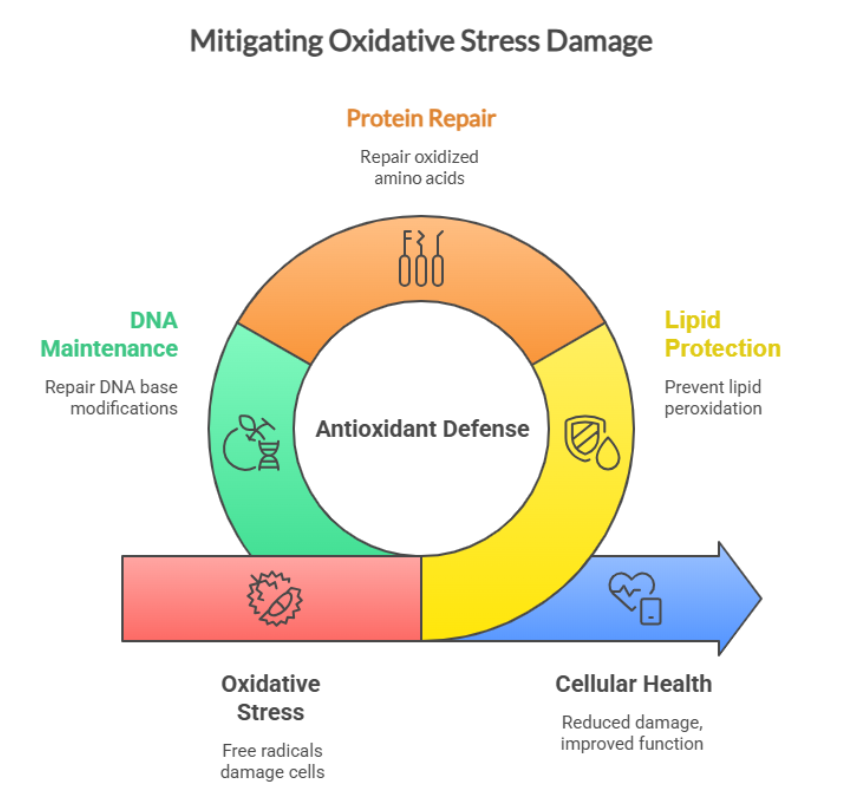
What happens when antioxidant defense falls behind?
When lipid and protein accumulate, and DNA damage occurs faster than the body can repair it, oxidative stress causes fatigue, premature aging, cardiovascular disease, diabetes, neurodegeneration, kidney disease and chronic inflammation.
But here’s the reassuring part: your body has its own antioxidant machinery designed to handle this stress. Let’s discuss this further in the next section.
How Your Body’s Built-In Antioxidant System Protects You
Your body is equipped with a highly sophisticated internal antioxidant network that works around the clock to neutralize free radicals, repair damage, and keep your cells functioning at their best. These include Glutathione, antioxidant enzymes (catalase, glutathione peroxidase), and Coenzyme Q10 (CoQ10).
- At the center of this defense is glutathione (GSH), often called the body’s “master antioxidant.”
- Glutathione directly neutralizes reactive oxygen species (ROS) and detoxifies harmful byproducts before they can injure your cells.
- When glutathione levels drop (aging, chronic stress, or inflammation), the body becomes far more vulnerable to oxidative damage and metabolic slowdown.
- Working alongside glutathione are powerful antioxidant enzymes, working day and night as quiet, tireless warriors.
Superoxide dismutase (SOD) converts highly reactive superoxide radicals into hydrogen peroxide, while catalase and glutathione peroxidase (GPx) break that hydrogen peroxide down into harmless water and oxygen.- Together, these enzymes protect your mitochondria, defend DNA, and reduce inflammation at the cellular level.
- Another essential player is CoQ10; the antioxidant embedded deep within mitochondrial membranes.
- CoQ10 supports in ATP energy production
- It also stabilizes mitochondrial structure and
- It prevents lipid peroxidation, making it especially important for the heart, brain, and muscle health.
Strong CoQ10 levels = stronger antioxidant protection, better energy, and healthier aging.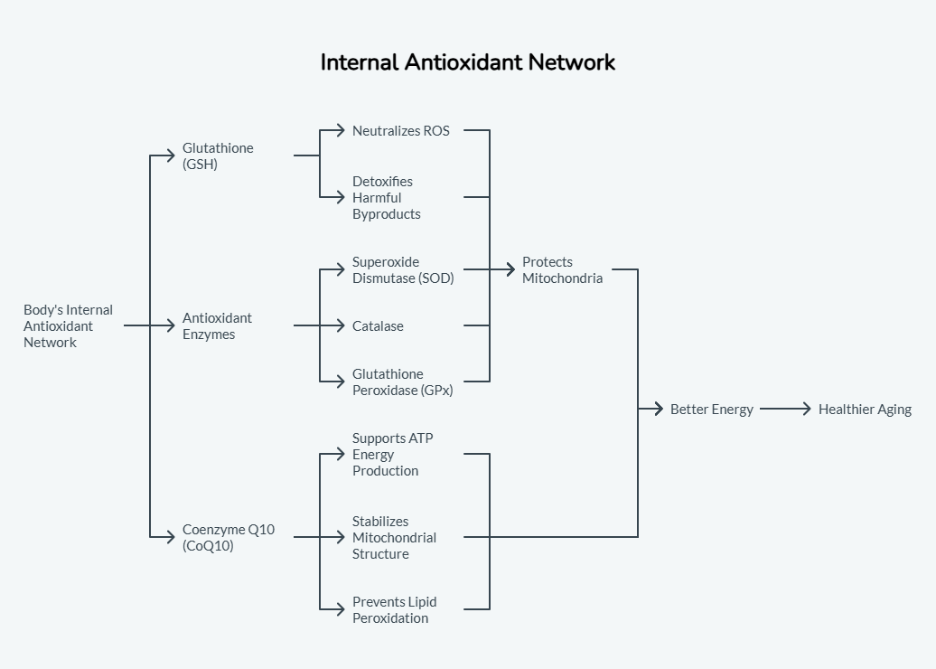
All these components work as your internal “antioxidant security team,” keeping oxidative stress under control so you can stay energized, mentally sharp, and biologically resilient.
And here’s the key connection: Instead of acting as a direct antioxidant, geranylgeraniol (GG) helps your body strengthen this entire built-in defense system. Let’s understand this in next section.
Geranylgeraniol (GG) is an isoprenoid naturally produced in the mevalonate pathway, the biochemical highway that generates cholesterol, steroid hormones, vitamin D, and CoQ10. GG plays three major roles
- It fuels CoQ10 biosynthesis
- Supports mitochondrial function
- Maintains cellular structure through protein prenylation(4)
Read more: A comprehensive guide to GG supplement
How GG Supports Antioxidant Capacity
1. GG Helps Your Body Make More CoQ10
- CoQ10 is one of the most powerful antioxidants in human physiology, but the body relies on the mevalonate pathway to produce it.
- GG is a crucial intermediate in this pathway. Without enough GG, CoQ10 production slows down, leaving mitochondria more vulnerable to oxidative damage. This explains why low-GG states (aging, statins) often coincide with fatigue and muscle weakness.(5)
Reduced GG → Reduced CoQ10 → weakened antioxidant defense.
Read more: CoQ10 Benefits: What is Coenzyme Q10 Used For?
2. GG Improves Mitochondrial Quality
- Healthy mitochondria produce fewer free radicals.
- Studies such as Jiwan et al. (2022, In Vivo) show that GG supplementation improved mitochondrial enzyme function and reduced oxidative stress markers in diabetic rats leading to healthier muscle tissue. (6)
- Better-functioning mitochondria are more efficient at energy production and generate far less oxidative “waste.”
3. GG Reduces Inflammation-Driven Oxidative Stress
- Chronic inflammation is one of the biggest drivers of oxidative stress.
- Research done by Chung et al. (2021, Nutrition Research) demonstrated that GG supplementation lowered inflammatory cytokines like IL-6 and MCP-1 in obese mice.
- By quieting inflammation, GG helps reduce the free radical load that inflammation normally triggers.(7)
| Study | Year | Design | N | Model | Dose | Duration | Key Results |
| Shen C-L et al. Effect of Dietary GG and Green Tea Polyphenols on Inflammation and Oxidative Stress in Obese Mice(8) | 2023 | Animal study | Not reported | Obese mice on high-fat diet | 400 mg/kg diet | 12 weeks | GG reduced pro-inflammation and oxidative stress by inhibiting NF-KB activation; improved overall redox balance |
| Meister M et al. Dietary Geranylgeraniol and Statins May Act in Synergy to Improve Metabolic Health(9) | 2022 | Animal study | Not reported | Obese mice treated with statins ± GG | 400 mg/kg diet | 10 weeks | GG improved mitochondrial function and reduced oxidative stress in statin-treated mice; restored redox homeostasis via the mevalonate pathway |
Evidence table: Recent Studies on GG and Oxidative Stress Reduction
Now, that we have seen how GG backs up your antioxidant system, you might wonder, how is it different from usual antioxidants we take? Let’s find out.
How GG Differs from Traditional Antioxidants
Most antioxidants we consume (vitamin C, vitamin E, polyphenols) work by directly neutralizing free radicals. GG works differently. It supports the internal pathways that power antioxidant production and mitochondrial efficiency. By supporting upstream pathways, GG enhances the body’s own long-lasting antioxidant machinery.(10)
Direct antioxidants are firefighters. GG helps in preventing fire in the first place.
Conclusion
Oxidative stress is universal and to counteract , your body has powerful built-in defenses. By supporting the mevalonate pathway and CoQ10 production, GG strengthens your antioxidant foundation from the inside out. Instead of working like a typical antioxidant, GG fuels the underlying system that keeps your cells protected, energized, and more resilient against daily oxidative challenges.
For individuals seeking deeper cellular support, GG is emerging as a promising, science-backed approach to oxidative stress management.
Key Takeaways
Oxidative stress occurs when free radicals exceed your body’s antioxidant capacity, leading to cellular damage, fatigue, and accelerated aging.
Your body has a built-in antioxidant defense system(glutathione, CoQ10, SOD, catalase, and GPx)that protects cells around the clock.
CoQ10 supports energy production and prevents lipid peroxidation, especially in heart and muscle tissues.
Geranylgeraniol (GG) fuels the mevalonate pathway, enabling CoQ10 biosynthesis and cellular repair processes.
GG strengthens the antioxidant system from the inside out, instead of acting like a direct antioxidant (e.g., vitamin C or E).
FAQ’S
Unlike vitamin C or E, GG doesn’t neutralize free radicals directly. Instead, it supports CoQ10 production and mitochondrial function thereby strengthening the body’s internal antioxidant defense system.
GG boosts CoQ10 biosynthesis, improves mitochondrial efficiency, and lowers inflammation-driven ROS production. These upstream effects reduce oxidative damage at the cellular level. You can read more on this
Statins reduce GG and CoQ10 through mevalonate pathway inhibition. Supplementing GG may help maintain CoQ10 levels and support muscle health. Always consult your healthcare provider.
Not directly. GG supports the pathways that produce antioxidants like CoQ10 and glutathione, making it a potent upstream antioxidant enhancer.
Adults over 40, statin users, athletes, people dealing with chronic stress, inflammation, pollution exposure, or low energy levels.
References
- Pizzino G, Irrera N, Cucinotta M, et al. Oxidative stress: harms and benefits for human health. Oxid Med Cell Longev. 2017;2017:8416763. doi:https://doi.org/10.1155/2017/8416763
- Valko M, Leibfritz D, Moncol J, Cronin MTD, Mazur M, Telser J. Free radicals and antioxidants in normal physiological functions and human disease. Int J Biochem Cell Biol. 2007;39(1):44-84. doi:10.1016/j.biocel.2006.07.001.
- Yang K, Cao F, Xue Y, Tao L, Zhu Y. Three classes of antioxidant defense systems and the development of postmenopausal osteoporosis. Front Physiol. 2022;13:840293. doi:10.3389/fphys.2022.840293.
- MuseChem. The Science of Geranylgeraniol: Why It Matters for Your Health. MuseChem Blog. Published March 13, 2025.
- Tan B, Chin KY. Potential role of geranylgeraniol in managing statin-associated muscle symptoms. Front Physiol. 2023;14:1246589. doi:10.3389/fphys.2023.1246589
- Jiwan NC, et al. Geranylgeraniol supplementation mitigates soleus muscle mitochondrial dysfunction in diabetic rats. Int J Oncol Res. 2022;36(6):2638-2646.
- Chung E, Elmassry MM, Cao JJ, Kaur G, Dufour JM, Hamood AN, Shen C-L. Beneficial effect of dietary geranylgeraniol on glucose homeostasis and bone microstructure in obese mice is associated with suppression of proinflammation and modification of gut microbiome. Nutr Res. 2021;93:27-37. doi:10.1016/j.nutres.2021.07.001
- Shen C-L, Elmassry MM, Cao JJ, et al. Beneficial effect of dietary geranylgeraniol on glucose homeostasis and bone microstructure in obese mice is associated with suppression of proinflammation and modification of gut microbiome. Nutr Res. 2021;93:27-37. doi:10.1016/j.nutres.2021.07.001
- Meister M, Shen C-L, Feresin R. Dietary geranylgeraniol and statins may act synergistically to mitigate oxidative stress in obese mice. Int J Environ Res Public Health. 2022;19(11):6639. doi:10.3390/ijerph19116639. PMCID: PMC9193629.
- Hashim OA, Numan IT, Mohammed NH. The protective effect of coadministration of coenzyme Q10 and vitamin E on myopathy induced by simvastatin in rats. Toxicol Rep. 2025;14:101942. doi:10.1016/j.toxrep.2025.101942. PMID: 40612652. PMCID: PMC12223430.
Leave a Reply