TL/DR
Tiny enzymes called Geranylgeranyl Transferases (GGTs) power your cells by activating proteins that regulate energy, CoQ10, and hormone balance. Geranylgeraniol (GG) fuels this pathway, helping your body generate energy naturally from within.
There are days when you do everything right; eat well, sleep on time, even take your vitamins, yet something still feels missing. Your energy feels slower; your recovery takes longer, and the spark that once made you feel alive seems dimmer.
Confused! Is it in your head? Before you blame your thoughts, listen closely! Your cells might be the ones calling for help.
Inside every cell, millions of tiny reactions happen each second as enzymes are working like caretakers, guiding your body’s energy, hormones, and healing. Among them are a group so small and so overlooked, yet so vital — Geranylgeranyl Transferases (GGT’s).
These are your body’s silent helpers. They make sure essential proteins reach their right place, that energy flows where it’s needed, and that your cells communicate in harmony.
When these enzymes slow down, your body feels it in small ways you can’t always explain.
But here’s the beautiful part, you can support them. Want to know how? Let’s uncover how these enzymes are formed, what they do and why they are vital for cellular life.
What Are Geranylgeranyl Transferases (GGT’s)?
Geranylgeranyl transferases are specialized enzymes that attaches a small lipid tail called geranylgeranyl groups (20- carbon chain) to certain proteins using a substrate known as GGPP (geranylgeranyl pyrophosphate).(1)
This process is known as geranylgeranylation.
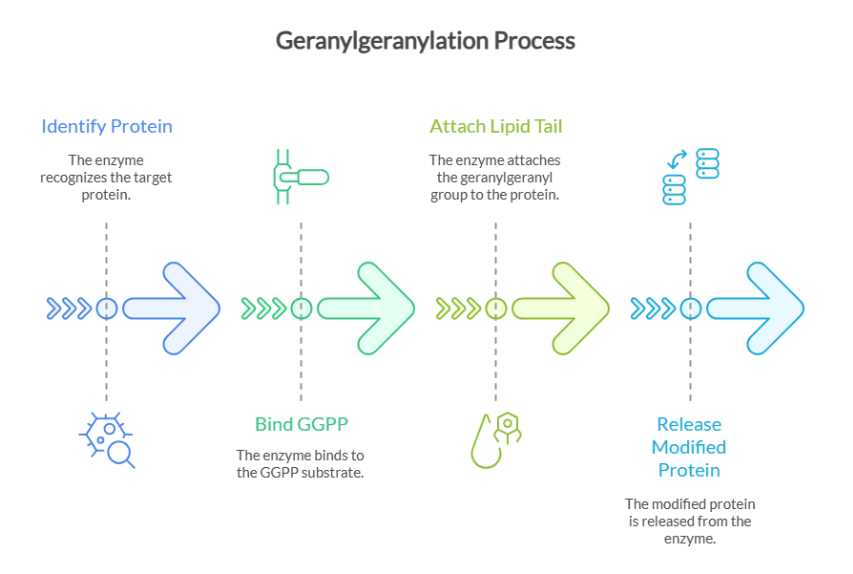
Imagine GGT’s as the cell’s docking engineers (enzymes) working to make sure vital proteins reach the exact place where they need to work. Every second, thousands of proteins inside your cells float freely in the cytoplasm. To become functional, many of them must attach to a cell membrane and that’s precisely what GGT’s come into action.
Ever wondered; how does a signaling molecule ‘know’ exactly where to plug in?
GGT’s act as molecular technicians that attach lipid tags to key proteins. Without their guidance, cell signaling would be like messages lost without an address.
How does geranylgeranyl transferase work?
- GGT’s act like molecular tailors, stitching a tiny lipid tail called a geranylgeranyl group (a 20-carbon isoprenoid chain) onto selected proteins (2)
- They take this lipid from a compound called geranylgeranyl pyrophosphate (GGPP), a crucial intermediate your cells make through the mevalonate pathway.
- This lipid tagging process, known as geranylgeranylation, changes the protein’s surface from water-loving to slightly oily or hydrophobic, allowing it to:
- Attach firmly to cell membranes
- Interact efficiently with other signaling molecules
- Stay active where it’s most needed, especially in processes like energy metabolism, hormone signaling, and cell communication (3).
Think of it as adding a molecular GPS tag that guides proteins to their cellular destination.
In the absence of this “molecular grip,” many vital proteins would just float aimlessly inside the cell, unable to perform their roles.
How Geranylgeranyl Transferases are formed: The mevalonate pathway connection
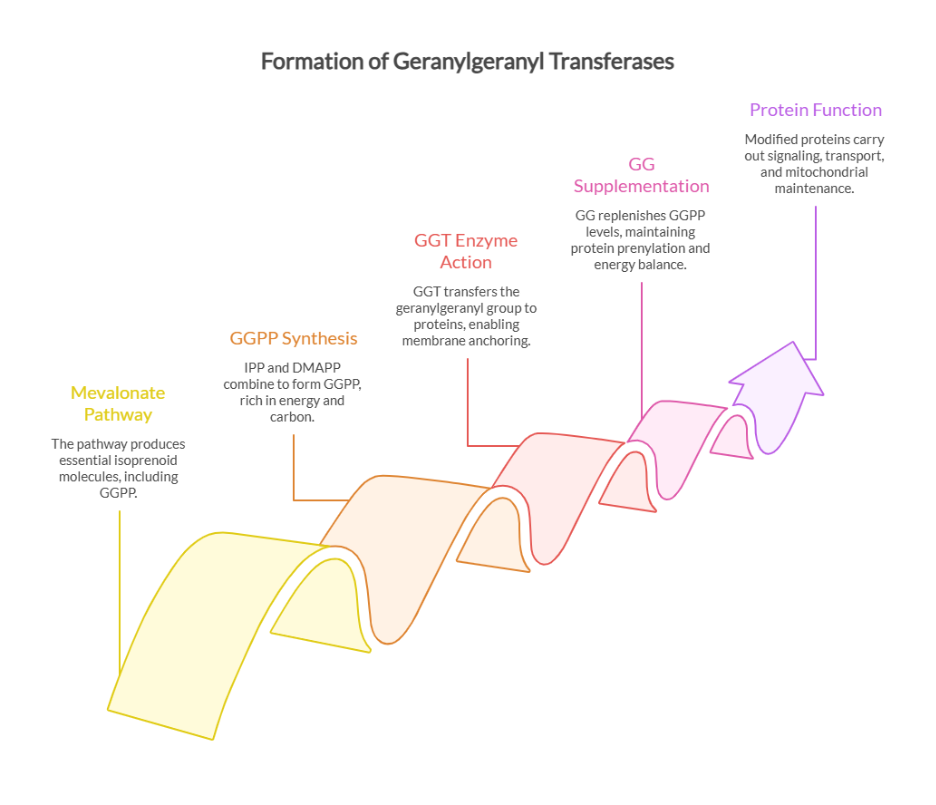
Step 1: The Pathway’s Big Picture
- The mevalonate pathway is your cell’s building factory for essential isoprenoid molecules — the raw materials for cholesterol, CoQ10, Vitamin K2, and GGPP.
- It starts from acetyl-CoA and proceeds through these key stages:
Acetyl-CoA → HMG-CoA → Mevalonate → Farnesyl pyrophosphate (FPP) → Geranylgeranyl pyrophosphate (GGPP).(4)
Think of GGPP as the “final ingredient” your enzymes use to tag and activate proteins.
Step 2: GGPP Is Born
- Once mevalonate forms isopentenyl pyrophosphate (IPP) and dimethylallyl pyrophosphate (DMAPP), they combine stepwise to form FPP and finally GGPP.
- This GGPP molecule is rich in high-energy phosphate bonds and carries a 20-carbon tail, the geranylgeranyl group.
Step 3: Enter GGT — The Specialist Enzyme
Now, Geranylgeranyl Transferase (GGT) steps in acting as a magical enzyme that uses this newly made GGPP.
- GGT “grabs” the GGPP molecule from the mevalonate pathway.
- It transfers the geranylgeranyl group from GGPP to the end (cysteine) of specific proteins such as Rho, Rab, and Ras GTPases.
- This transfer is called geranylgeranylation.
As a result, protein gets a lipid tail, allowing it to anchor to cell membranes and carry out signaling, transport, and mitochondrial regulation. (5,6)
Step 4: How GG (Geranylgeraniol) Keeps the Process Alive
The entire process depends on a steady supply of GGPP, and this is where Geranylgeraniol (GG) shines.
- When the mevalonate pathway slows (as in aging or during statin therapy), GGPP drops.
- Supplemented GG can re-enter the pathway, being converted by the cell into GGPP again
- That replenished GGPP keeps GGT’s active → ensures proteins stay prenylated → maintains energy metabolism and hormone balance.
Read more: A comprehensive guide to GG supplementation
Step 5: Where the Pathway Feeds Forward
- After GGT uses GGPP to tag proteins, the modified proteins carry out membrane signaling, vesicle transport, and mitochondrial maintenance.
- CoQ10 synthesis, also dependent on the mevalonate route, benefits indirectly from this same biochemical energy pool.
In simpler words:
The mevalonate pathway makes the tools (GGPP). Geranylgeranyl Transferase (GGT) uses those tools to activate proteins. Geranylgeraniol (GG) ensures the factory never runs out of supplies.
Now that we have understood where GGT’s come from, let’s explore the two key types of GGT’s and their distinct cellular role
Two types, one goal: Keeping proteins in place
- Geranylgeranyl Transferases (GGT’s) may be tiny, but they act as your cell’s electrical wiring team, connecting proteins to their proper places so your body’s communication lines never break.
- When these enzymes do their job right, your cells stay active, your energy remains steady, and your body repair system runs smoothly.
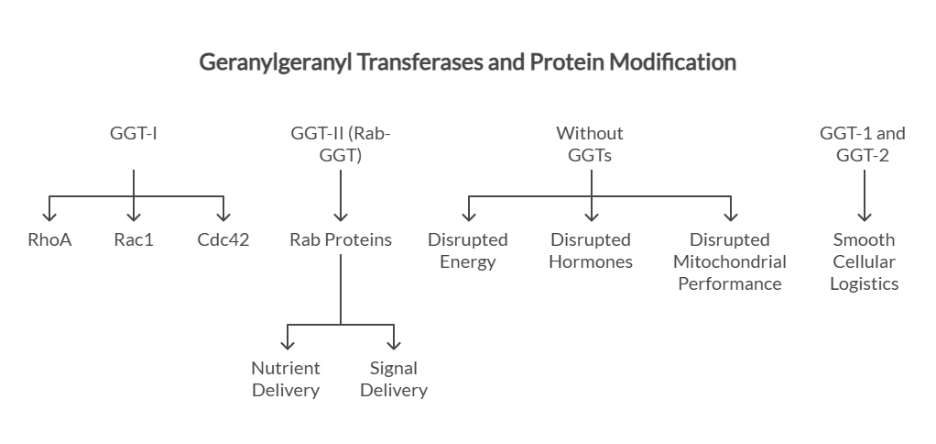
Your body uses two main types, each working with different protein families:
- GGT-I modifies signaling proteins such as RhoA, Rac1, and Cdc42, which regulate cell growth, muscle tone, and stress response
- GGT-II (Rab-GGT) specializes in Rab proteins, which manage vesicle transport, acting as the traffic controllers and ensuring nutrients and signals reach where they are needed.
Without these enzymes, critical proteins remain misplaced like unanchored boats drifting away from the dock; disrupting energy, hormones, and even mitochondrial performance.
package (protein)Together, GGT-1 and GGT-2 keep your cellular logistics running smoothly like two specialized delivery crews, ensuring every package(protein) reaches its target.(7)
Why Healthy Geranylgeranyl Transferases (GGT’s) are Important!
Active Geranylgeranyl Transferases (GGT’s) keep your cells energized and connected supporting vital processes that define how youthful and resilient you feel.
Healthy GGT function supports:
- Mitochondrial strength → steady cellular energy
- CoQ10 synthesis → heart and antioxidant health
- Vitamin K₂ activation (MK-4) → bone and vascular support
- Hormone balance → vitality and stable mood
When GGT activity declines, energy, strength, and communication between cells weaken.
That’s where exactly GG steps in to revive the process.
Geranylgeranoil(GG) Keeps the Enzyme Engine Running
GG → GGPP → GGT → Protein Activation → Cellular Energy + Hormone Balance
- GG acts as the starting spark that feeds the mevalonate pathway.
- GGT uses GGPP, derived from GG, to attach 20-carbon lipid tails to key signaling proteins (Rho, Rab, Ras).(8)
- These activated proteins help drive mitochondrial energy, CoQ10 synthesis, and vitamin K₂ (MK-4) activation, acting as strong foundation for healthy muscles, a healthy heart, and balanced aging. (9)
As we age, supplementing with GG can help sustain this delicate balance, ensuring that your cells keep communicating and performing at their best.
Also Read: Maximizing Muscle Health: The Role of Geranylgeraniol for Muscle Function
Conclusion:
GGT’s are the quiet architects of cellular vitality, keeping proteins active and energy flowing. Their strength depends on natural compound GG which fuels GG → GGPP → GGT pathway, your body’s built-in energy circuit.
When this pathway slows with age or stress, mitochondrial performance, CoQ10 synthesis, and hormone balance begin to decline. Supporting it with GG supplementation helps replenish GGPP, keeping GGT’s active and your cells energized from within.
Also read: The Secret To Long-Lasting Energy Revealed – Ubiquinol + GG
Key Takeaways
- GGTs are tiny enzymes that anchor proteins to cell membranes, ensuring smooth energy flow, signaling, and repair.
- They rely on GGPP produced from GG through the mevalonate pathway to activate vital proteins like Rho, Rab, and Ras.
- The chain GG → GGPP → GGT → Active Proteins fuels mitochondrial performance, CoQ10 synthesis, vitamin K₂ (MK-4) activation, and hormone balance.
- Two enzyme types share the workload:
- GGT-I → modifies signaling proteins (Rho, Rac, Rap) for growth and stress response.
- GGT-II (Rab-GGT) → activates Rab proteins for intracellular transport.
- Adequate GG/GGPP levels sustain energy, signaling, and cellular vitality.
FAQs
GGT’s activate key proteins that regulate mitochondrial energy, hormone signaling, and antioxidant defense which are fundamental processes for maintaining vitality and healthy aging.
With aging, stress, or statin therapy, GGPP levels drop. As a result, GGT enzymes slow down leading to reduced cellular energy, weaker muscle tone, slower recovery, and hormonal imbalance.
Individuals experiencing low energy, muscle fatigue, aging-related mitochondrial decline, or those taking statins may benefit most from GG to support cellular energy and muscle strength.
Geranylgeranoil is a naturally occurring nutrient found in foods like sunflower oil and used in scientific research; supplementation is generally well-tolerated, though individuals on medications should consult a healthcare professional.
GG supports protein activation and mitochondrial efficiency, which improves muscle strength, endurance, and repair especially in aging and metabolic stress conditions.
References
- Taylor JS, Reid TS, Terry KL, Casey PJ, Beese LS. Structure of mammalian protein geranylgeranyltransferase type-I. EMBO J. 2003;22(22):5963-5974. doi:10.1093/emboj/cdg571.
- Zhang FL, Casey PJ. Protein prenylation: Molecular mechanisms and functional consequences. Annu Rev Biochem. 1996;65:241-269.
- .Leung KF, Baron R, Seabra MC. Geranylgeranylation of Rab GTPases. J Lipid Res. 2006;47(3):467-475.
- Miziorko HM. Enzymes of the mevalonate pathway of isoprenoid biosynthesis. Arch Biochem Biophys. 2011;505(2):131-143. PMC+1
- Buhaescu I, Izzedine H. Mevalonate pathway: a review of clinical and therapeutical implications. Clin Biochem. 2007;40(9–10):575-584. PubMed+1
- Phillips HM. Protein geranylgeranylation: a possible new player in cardiovascular biology. Cardiovasc Res. 2018;114(7):922-930. OUP Academic
- Hinz S, Zimmer A, Perner J, et al. Molecular and pharmacological characterization of geranylgeranyltransferase type-I as a therapeutic target. Int J Mol Sci. 2021;22(5):2501
- Wright LP, Philips MR. CAAX modification and membrane targeting of Ras. J Lipid Res. 2006;47(5):883-891.
- Paul C, Brady DM, Tan B. Geranylgeraniol boosts endogenous synthesis of Coenzyme Q10 and cell-essential metabolites, overcoming CoQ10 supplementation limitations. 2021.
Leave a Reply