TL/DR
Energy is neither created nor destroyed; it can only be converted from one form to another. Your mitochondria transform nutrients into fuel, powering every heartbeat and movement. Supporting these tiny engines helps sustain strength, focus, and vitality. They keep you energized from cells to self.
Ever wonder why you feel tired all the time, even after resting? Well, it could be a sign that your cells (the very engines of your body) aren’t getting the support they need. Feeling tired isn’t unusual, but when fatigue, muscle weakness, and metabolic slowdown become a daily struggle, it signals something deeper.
The search for answers often points to mitochondria, the powerhouses of our cells. These tiny organelles generate ATP, the universal energy currency that fuels everything from a steady heartbeat to sharp thinking.
But where does Geranylgeraniol (GG) fit into this equation?
Most conversations around mitochondrial health stop at CoQ10, the well-known electron carrier in the energy chain. But what if another overlooked molecule sits upstream, shaping how much CoQ10 gets made and how efficiently mitochondria run? That’s where geranylgeraniol (GG) enters the picture.(1)
Let’s explore more.
What is Cellular Energy?
Cellular energy refers to the power that cells generate and use to perform all their vital functions by forming ATP, which fuels nearly every cellular activity including
- Muscle contraction
- Nerve impulse transmission
- Active transport of nutrients across membranes
- DNA synthesis and cell repair.
Without a steady supply of cellular energy, cells cannot grow, communicate, or maintain their structure. So, now that we know why ATP matters, Let’s hunt for the real home of ATP!
Where is ATP formed?
- Most ATP is made inside tiny cell structures called mitochondria, where energy is produced through a process called oxidative phosphorylation, which depends on the electron transport chain (a sequence of protein complexes that pass electrons and create the force needed to generate ATP).(2)
- A vital helper in this chain is Coenzyme Q10 (CoQ10), which acts as an electron carrier and a cell-protective antioxidant which ensures efficient energy production.(3)
However, the story doesn’t end with CoQ10.
Molecules upstream of CoQ10, such as geranylgeraniol (GG), are essential for its biosynthesis. In the absence of enough GG, CoQ10 levels and energy balance can fall.
GG helps your cells make CoQ10 which keeps mitochondria running. Together, they form your body’s core energy loop.
What Are Mitochondria and Why Are They Important?
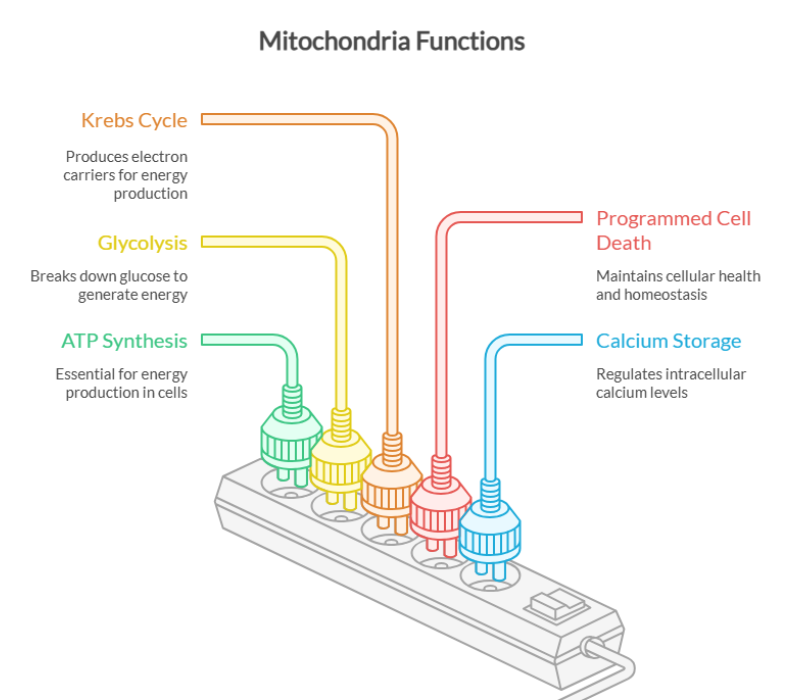
Mitochondria take the food you eat (glucose and fats) and convert it into ATP through a process known as cellular respiration. This process happens in two main steps:
- The Krebs Cycle: breaks down nutrients to release electrons.
- The Electron Transport Chain (ETC): where these electrons create energy used to make ATP.
Think of it like a mini energy factory; raw materials (food) go in, and clean fuel (ATP) comes out.
Guess what? You will be surprised to know that mitochondria do more than just make energy. They help control cell growth, repair damage, and even decide when a cell should die (a process important for removing unhealthy cells and preventing disease).
Cells with high energy needs, such as muscle or brain cells, have many mitochondria to keep up with constant demand.(4)
Why Mitochondrial Health Matters?
- Healthy mitochondria enable cells to generate sufficient energy for normal function.
- Damaged mitochondria produce less energy and more free radicals. Factors such as poor diet, chronic stress, aging, and environmental toxins can impair mitochondrial function.
- Excess free radicals lead to oxidative stress, which contributes to aging and chronic diseases (diabetes, Alzheimer’s, heart disease).
- Supporting and protecting mitochondria is essential for sustained energy, healthy cells, and overall well-being. (5)
Geranylgeraniol (GG): The Mitochondrial Connector
As we have discussed earlier, inside every cell, mitochondria acts as your body’s power plants, producing ATP. Can you guess the key raw material that fuels these power plants?
You’re right-that’s exactly where our star molecule GG steps in.
What Is Geranylgeraniol?
- Geranylgeraniol (GG) is a naturally occurring isoprenoid compound synthesized through the mevalonate pathway, the same biochemical route that produces cholesterol, CoQ10, and vitamin K2.
- It is a vital building block that supports the body’s internal CoQ10 synthesis and helps maintain healthy mitochondrial function.
How GG Fuels Mitochondrial Energy?
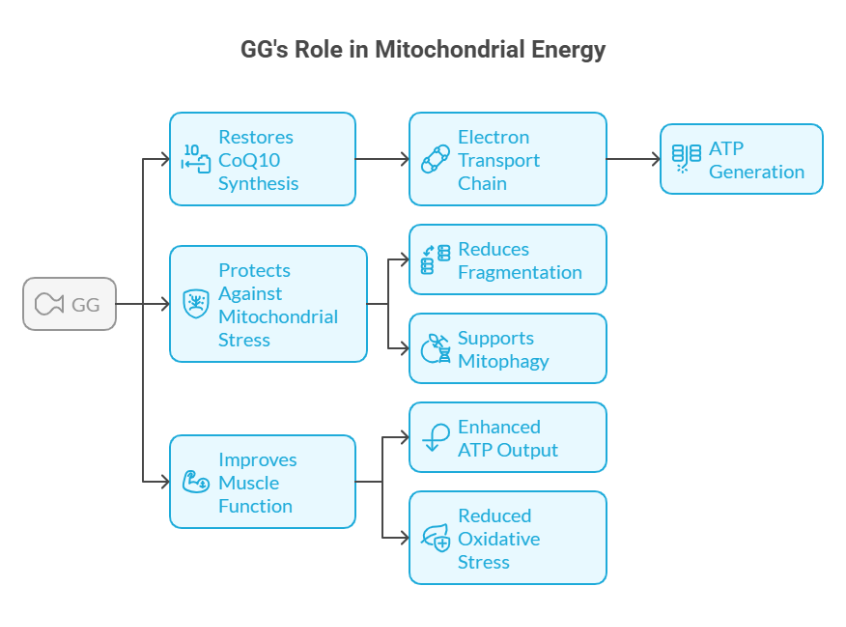
- Restores CoQ10 Synthesis:
- GG serves as a precursor for Coenzyme Q10 (ubiquinone)—an essential molecule in the electron transport chain where cellular energy (ATP) is generated.
- When the mevalonate pathway is disrupted (e.g., by statins), CoQ10 levels drop, impairing mitochondrial efficiency.(3),(6)
- In a Study published “Potential role of geranylgeraniol in managing statin-associated muscle symptoms: a COVID-19 related perspective” it was observed that GG supplementation can restore endogenous CoQ10 levels and revive mitochondrial respiration in such conditions. (7)
- Protects Against Mitochondrial Stress:
- GG reduces mitochondrial fragmentation, a hallmark of cellular stress and supports mitophagy (the recycling of damaged mitochondria) through PINK1 signaling.(8)
- In animal and cell models, GG has shown protective effects against statin-induced muscle toxicity and diabetic muscle weakness, both linked to mitochondrial dysfunction.(9)
- Improves Muscle Function and Bioenergetics:
- Supplementing GG has been associated with improved muscle fiber quality, enhanced ATP output, and reduced oxidative stress(6)˒(7)
GG’s Role in Mitochondrial Energy
Important Advice:
Avoid GG, if you’re on warfarin or any other blood thinners, as they influence Vitamin K2 activity, which can affect blood clotting balance.
Evidence Table
| Study title | Year | Design | Population/Model | Key Outcome | Major Findings |
| Geranylgeraniol induces mitophagy via PINK1(10) upregulation in skeletal muscle cells | 2022 | In vitro | Skeletal muscle cells | Mitophagy (PINK1) mitochondrial morphology | GG triggered mitophagy, reduced mitochondrial fragmentation, and enhanced mitochondrial quality control. |
| Geranylgeraniol attenuates statin-induced skeletal muscle damage through mitochondrial protection(11) | 2018 | Animal study | Statin-treated rats | Mitochondrial dysfunction & myopathy | GG restored mitochondrial structure, improved ATP generation, and reduced muscle atrophy markers |
| Dietary geranylgeraniol improves mitochondrial function and muscle performance in aged mice(12) | 2021 | Animal study | Aged mice | Aging-related mitochondrial decline and muscle performance | GG improved muscle strength, mitochondrial membrane potential, and oxidative capacity; reduced inflammation and oxidative stress. |
| The mevalonate pathway, geranylgeraniol, and mitochondrial function: a therapeutic connection(13) | 2021 | Mechanistic review | Mevalonate pathway model | CoQ10 biosynthesis, prenylation link | Identified GG as a key isoprenoid restoring CoQ10 synthesis and protein prenylation under statin inhibition. |
| Geranylgeraniol boosts endogenous CoQ10 synthesis and cell-essential metabolites, overcoming CoQ10 supplementation limitations(6) | 2021 | Review / Commentary | Human cell metabolism overview | CoQ10 and energy metabolism | Demonstrated GG’s role in enhancing endogenous CoQ10 and energy output more efficiently than CoQ10 alone. |
| Potential role of geranylgeraniol in managing statin-associated muscle symptoms: a COVID-19 related perspective(7) | 2023 | Clinical perspective | Human (statin users) | Statin-associated muscle symptoms (SAMS) | Proposed GG as an adjunct nutrient to prevent mitochondrial dysfunction and myopathy in statin users. |
Conclusion: Energy That Starts Within You
Think of Geranylgeraniol (GG) as your cell’s gentle reminder of how to make its own power again. Instead of just giving your body more fuel, GG helps reignite your natural energy-making system by supporting CoQ10 production and repairing those hardworking mitochondria that keep you moving, thinking, and feeling alive.
It’s fascinating, isn’t it? A tiny molecule helping your cells remember how to thrive. Whether it’s easing statin-related fatigue, protecting muscle strength as you age, or simply helping you feel more energized in day to day life.
GG reminds us that real energy isn’t something you plug in, it’s something your body regenerates, one mitochondrion at a time. So instead of just fueling up, why not empower your body to recharge itself naturally.
Key Takeaways:
- Mitochondria are the body’s true power engines, generating ATP to fuel every heartbeat, thought, and movement.
- Aging, stress, poor nutrition, and statins weaken mitochondrial function, leading to low energy and muscle decline.
- Stronger mitochondria support stamina, cognitive clarity, hormone balance, and vitality.
- Nutrients like GG, CoQ10, and Vitamin K2 work together to power energy production and protect mitochondrial health.
- Real strength starts inside the cell, support mitochondria for steady, lasting energy.
- When your cells thrive, your whole body follows.
FAQ’s
GG is a naturally occurring nutrient that helps your body produce CoQ10 and Vitamin K2, supporting cellular energy, muscle strength, and metabolic balance.
GG powers your body’s CoQ10 synthesis, fueling mitochondria (the energy engines inside every cell)
No. GG is the precursor, while CoQ10 is the end product that generates ATP (energy)
Yes, current research indicates that GG is well-tolerated and safe.
Yes, they work best in synergy (taken in combination)
References
- Fliefel RM, Entekhabi SA, Ehrenfeld M, Otto S. Geranylgeraniol (GGOH) as a Mevalonate Pathway Activator in the Rescue of Bone Cells Treated with Zoledronic Acid: An In Vitro Study. J Biol Chem. 2019; PMC6343170. https://pmc.ncbi.nlm.nih.gov/articles/PMC6343170/
- Hargreaves M, Spriet LL. Exercise metabolism: Fuels for the fire. Cold Spring Harb Perspect Med. 2018;8(8):a029744. doi:10.1101/cshperspect.a029744
- Bentinger M, Tekle M, Dallner G. Coenzyme Q—biosynthesis and functions. Biochem Biophys Res Commun. 2010;396(1):74–79. doi:10.1016/j.bbrc.2010.02.147
- Anwar A, et al. Natural compounds supporting mitochondrial health in aging. Front Pharmacol. 2023;14:1057267.
- Brand MD, Nicholls DG. The role of mitochondrial function and cellular bioenergetics in ageing and disease. Br J Dermatol. 2013;169(Suppl 2):1–8. doi:10.1111/bjd.12208
- Ogura K, et al. The role of geranylgeraniol in endogenous CoQ10 biosynthesis and mitochondrial function. Townsend Lett. 2021;455:48-52
- Tan B, Chin K-Y. Potential role of geranylgeraniol in managing statin-associated muscle symptoms: a COVID-19 related perspective. Front Physiol. 2023;14:1246589. doi:10.3389/fphys.2023.1246589. PMID: 38046949
- Tanaka S, et al. Geranylgeraniol induces mitophagy via PINK1 upregulation in skeletal muscle. J Nutr Biochem. 2022;105:109009. doi:10.1016/j.jnutbio.2022.109009
- Wada T, et al. Dietary geranylgeraniol improves mitochondrial function and muscle performance in aged mice. Nutrients. 2021;13(4):1184. doi:10.3390/nu13041184
- Singh F, Wilhelm L, Prescott AR, Ostacolo K, Zhao J-F, Ogmundsdottir MH, Ganley IG. PINK1 regulated mitophagy is evident in skeletal muscles. Autophagy Reports. 2024;3(1):2326402. doi:10.1080/27694127.2024.2326402
- Jaśkiewicz A, Pająk B, Litwiniuk A, Urbańska K, Orzechowski A. Geranylgeraniol Prevents Statin-Dependent Myotoxicity in C2C12 Muscle Cells through RAP1 GTPase Prenylation and Cytoprotective Autophagy. Oxid Med Cell Longev. 2018;2018:6463807. doi:10.1155/2018/6463807.
- Jiwan NC, Appell CR, Wang R, Shen CL, Luk HY. Geranylgeraniol supplementation mitigates soleus muscle atrophy via changes in mitochondrial quality in diabetic rats. In Vivo. 2022;36:2638–2649. PMID: 36309365.
- Tricarico PM, Crovella S, Celsi F. Mevalonate pathway blockade, mitochondrial dysfunction and autophagy: a possible link. Int J Mol Sci. 2015;16(7):16067-16084. doi:10.3390/ijms160716067.
Leave a Reply