TL/DR-
The mevalonate pathway is your cell’s biochemical highway. Starting from acetyl-CoA, it passes through key checkpoints ending with the production of Geranylgeraniol (GG) — a vital compound for energy and mitochondrial function.
Inside every cell, a silent symphony of thousands of reactions unfolds, orchestrating the chemistry of life. These cellular pathways act like roadmaps, guiding molecules through a series of steps to produce energy, synthesize proteins, repair damage, and maintain balance. Without such order, cellular chemistry would be chaotic and inefficient.
Wondering! What is the mevalonate pathway?
At the heart of this symphony lies the mevalonate pathway—a central metabolic route that gives rise to vital biomolecules. Among these fascinating products, geranylgeraniol (GG) emerges as a molecule of special interest.
The Mevalonate Pathway and GG: Is It a Hidden Link Powering Cells, Hormones and Health?
Let’s decode together.
GG represents a molecular bridge between basic metabolism and advanced cellular functions. Understanding how the mevalonate pathway transforms simple precursors into GG gives us a glimpse of the inner blueprint of vitality.
It’s a reminder that the chemistry of life is not abstract; it’s happening inside us every moment, shaping wellness and longevity.
The Mevalonate Pathway: Your Body’s Molecular Superhighway
The mevalonate pathway is like your body’s molecular superhighway; a bustling network where raw biochemical “fuel” is transformed into life-sustaining products.
It starts with acetyl-CoA, a small carbon building block generated from fats, carbohydrates, and proteins. Through a series of tightly regulated steps, acetyl-CoA is transformed into mevalonate which acts like a pivotal gateway molecule unlocking multiple downstream routes.
From this point, the pathway produces cholesterol, steroid hormones, vitamin D, CoQ10, and GG, each playing a critical role in metabolism, energy, and cellular repair.1
Step by Step Conversion: From Mevalonate to Geranylgeraniol
Ready for a quick tour of mevalonate pathway?.
Let’s take it step-by-step and unjam the molecular traffic!
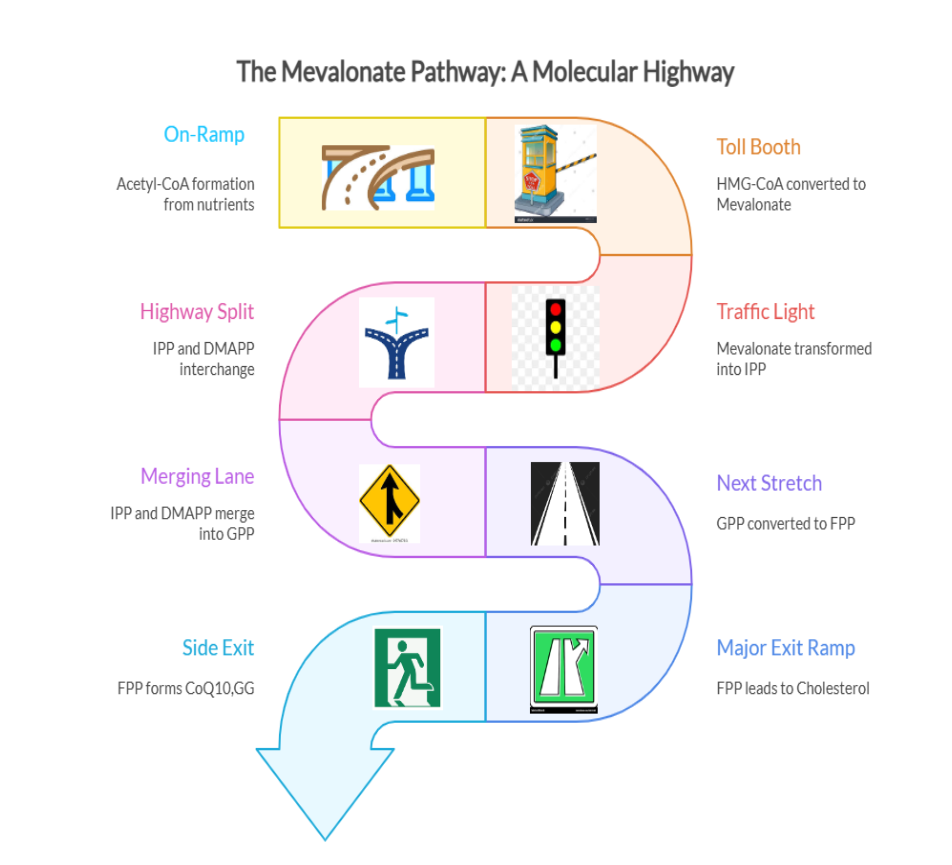
Imagine mevalonate pathway as a molecular highway system with multiple checkpoints that control the flow of essential compounds.
- It all begins at the on-ramp, where nutrients such as carbohydrates, fats, and proteins are broken down into acetyl-CoA, the basic fuel that feeds onto the highway.1
- Acetyl CoA undergoes a process (condensation reaction) with another acetyl CoA to form Aceto Acetyl CoA.
Acetyl-CoA + Acetyl-CoA → (Condensation Reaction) → Acetoacetyl-CoA - Now, Aceto Acetyl CoA combines with another Acetyl CoA (Addition reaction) to form HMG-CoA (3-Hydroxy-3-methylglutaryl-coenzyme A)
- The first major toll booth is the conversion of HMG-CoA into mevalonate, a critical control point. In this, HMG-CoA reductase enzyme reduces HMG-CoA to mevalonate using NADPH. (the body’s power bank).(2)
1. It’s the rate-limiting step — much like the busiest toll plaza that regulates traffic flow
2. Statins work by slowing traffic here, lowering cholesterol but also reducing downstream molecules like CoQ10 and Geranylgeraniol.
- Once mevalonate is formed, phosphorylation steps take place.
Let’s discuss in short
- Mevalonate is phosphorylated to Mevalonate-5-Phosphate by enzyme Mevalonate kinase(3)
- Mevalonate-5-Phosphate gain phosphate from ATP via phosphomevalonate kinase and form Mevalonate-5-Diphosphate
Mevalonate-5-Diphosphate undergoes decarboxylation and phosphorylation by mevalonate-5-diphosphate decarboxylase → producing Isopentenyl Pyrophosphate (IPP) + CO₂ + Pi. - Thus, in this pathway, enzymes act like traffic lights, converting mevalonate into smaller building blocks known as isopentenyl pyrophosphate (IPP) and dimethylallyl pyrophosphate (DMAPP).
- These building blocks then merge to form geranyl pyrophosphate (GPP), and with additional steps, farnesyl pyrophosphate (FPP).
- Think of FPP as a major junction where the road splits into different exits. One exit takes you to cholesterol, essential for cell membranes, hormones, and vitamin D. Another side exit produces coenzyme Q10 (CoQ10), a vital player in energy production and antioxidant defense(2)
- Yet another route forms geranylgeranyl pyrophosphate (GGPP), which gives rise to geranylgeraniol (GG), supporting protein signaling (and healthy cellular function.(4)
- GG is the end-product of the road trip delivering bioactive benefits that support:
- Cellular energy balance
- Mitochondrial function
- Hormone and immune regulation
- Anti-inflammatory pathways
By visualizing this pathway as a traffic system, it becomes easier to understand how biochemical balance directly influences vitality, energy, and longevity.
| Checkpoint (Traffic Stop) | Biochemical Step | Molecule Produced (Traffic Destination) | Health Significance |
| On-Ramp | Acetyl-CoA formation | Acetyl-CoA | Fuel from carbs, fats, proteins |
| Toll Booth | HMG-CoA → Mevalonate | Mevalonate | Central control point of pathway |
| Traffic Light | Mevalonate → Isopentenyl pyrophosphate (IPP) | IPP | Building block for many biomolecules |
| Highway Split | IPP ↔ Dimethylallyl pyrophosphate (DMAPP) | DMAPP | Alternate building block for isoprenoids |
| Merging Lane | IPP + DMAPP → Geranyl pyrophosphate (GPP) | GPP | Precursor for longer chains |
| Next Stretch | GPP + IPP → Farnesyl pyrophosphate (FPP) | FPP | Key branching point molecule |
| ️ Major Exit Ramp | FPP → Squalene → Cholesterol | Cholesterol | Cell membranes, hormones, vitamin D |
| Side Exit | FPP → Ubiquinone (CoQ10) | CoQ10 | Energy production, antioxidant |
| Side Exit | FPP → Geranylgeranyl pyrophosphate (GGPP) → Geranylgeraniol | GG | Protein prenylation, cellular signaling |
| Traffic Jam | Pathway imbalance (overactive or blocked) | – | Linked to cardiovascular disease, inflammation, statin side effects |
Geranylgeraniol: Tiny Molecule, Mighty Impact
GG is gaining attention as more than just a chemical intermediate. Let’s find out how?
- It is a biologically significant molecule that touches multiple aspects of human health.
- One of its central roles lies in Protein prenylation(4), a process that enables key proteins to anchor within cell membranes, ensuring proper cell signaling and communication.
- This same pathway connects GG to the biosynthesis of coenzyme Q10 (CoQ10), a vital compound for cellular energy production and antioxidant defense.(5)
- Beyond cellular mechanics, GG is increasingly studied for its influence on hormone regulation, particularly testosterone metabolism, which has implications for vitality and healthy aging.
- Its importance extends to maintaining energy, supporting mitochondrial function, and potentially supporting muscle and bone strengthening.
GG represents the bridge between biochemistry and longevity, highlighting why natural compounds like this are becoming focal points in discussions of wellness, healthy aging, and preventive health.(6)
What Happens if Mevalonate Pathway is Blocked?
Ever wondered if you get a traffic block with no entry ahead?
As mevalonate pathway is a critical biochemical route, if this pathway is inhibited by drugs like statin (medications designed to lower cholesterol) several downstream effects occur:
- Cholesterol synthesis declines, reducing hormone production (e.g., testosterone, estrogen, vitamin D)
- CoQ10 levels drop, leading to reduced mitochondrial energy and may contribute to muscle fatigue or weakness.
- Geranylgeraniol (GG) production decreases, impairing protein prenylation, which may affect bone and muscle health, testosterone balance, and neurological signaling.(6)
- Cell signaling disruptions can occur, impacting processes tied to immune function and cognition.(7)
Conclusion
From pathway to powerhouse, GG emerges from mevalonate routes as more than just a by-product; it acts like a key player in energy, strength and balance.
This pathway carries special importance because it fuels processes that touch nearly every aspect of health, as cholesterol balance influences heart health, while CoQ10 and geranylgeraniol connect directly to vitality and healthy aging.
This pathway can be seen as both a marvel and a risk. When finely tuned, it sustains resilience, but when overactive or blocked, it can drive disorders ranging from cardiovascular disease to inflammation.
Understanding this “highway” builds trust in the science of how everyday choices ripple down to molecular health and how the tiniest molecules can shape the biggest outcomes in wellness, making GG a true powerhouse of cellular health.
Key Takeaways
- The Mevalonate Pathway = Metabolic Highway producing cholesterol, CoQ10, and GG.
- GG drives protein prenylation, energy balance, and cellular signaling.
- GG + CoQ10 act as complementary molecules thereby one powers, the other connects.
- Disruption (e.g., statins) lowers CoQ10 and GG, impacting vitality and muscle health.
- Supporting GG levels may enhance mitochondrial performance, hormone balance, and healthy aging.
FAQ’s
The mevalonate pathway produces cholesterol, CoQ10 and products like GG.
GG plays a crucial role in protein prenylation, a process that anchors proteins to cell membranes so they can communicate properly.
GG is a building block in the synthesis of CoQ10, a vital molecule for mitochondrial energy production and overall vitality. Low GG can mean less energy at the cellular vel.
Yes. Studies suggest GG supports bone health, testosterone balance linking it with healthy aging and resilience.
Adults over 40, people on statins, athletes with high mitochondrial demand, individuals experiencing fatigue, muscle weakness or metabolic stress.
References
- Sharma P. The Mevalonate Pathway: Central Hub of Cholesterol Metabolism, Isoprenoid Biosynthesis, and Disease Mechanisms. Published November 2025. Accessed November 10, 2025.
- Buhaescu I, Izzedine H. Mevalonate pathway: a review of clinical and therapeutical implications. Clin Biochem. 2007;40(9-10):575-584. doi:10.1016/j.clinbiochem.2007.03.016
- Miziorko HM. Enzymes of the mevalonate pathway of isoprenoid biosynthesis. Arch Biochem Biophys. 2011;505(2):131-143. doi:10.1016/j.abb.2010.09.028
- Palsuledesai CC, Distefano MD. Protein prenylation: enzymes, therapeutics, and biotechnology applications. ACS Chem Biol. 2015;10(1):51-62. doi:10.1021/cb500791
- Bentinger M, Tekle M, Dallner G. Coenzyme Q–biosynthesis and functions. Biochem Biophys Res Commun. 2010;396(1):74-79. doi:10.1016/j.bbrc.2010.02.147
- Saputra WD, Shono H, Ohsaki Y, Sultana H, Komai M, Shirakawa H. Geranylgeraniol inhibits lipopolysaccharide-induced inflammation in mouse-derived MG6 microglial cells via NF-κB signaling modulation. Int J Mol Sci. 2021;22(19):10543. doi:10.3390/ijms221910543
- Saisho Y. Statin-induced diabetes and its clinical implications. Diabetes Metab J. 2014;38(4):239-246. doi:10.4093/dmj.2014.38.4.23
Leave a Reply